
Last Chance to Register Online for SIGGRAPH Asia 2014

Last Chance to Register Online for SIGGRAPH Asia 2014

SIGGRAPH Asia, Asia's largest and most respected conference on computer graphics, will take place this year from December 3 to 6 in Shenzhen, China. Online registration for the conference closes on November 20.

Nearly 8,000 attendees from over 60 countries are expected at SIGGRAPH Asia 2014. Experts from a wide range of fields will be in attendance, including top-level professionals in key areas such as hardware, software, film production, game production, research and education. Presenters and exhibitors at the conference will unveil cutting edge graphical and technical achievements at a furious rate.
SIGGRAPH 2013 Pacific Rim Talk

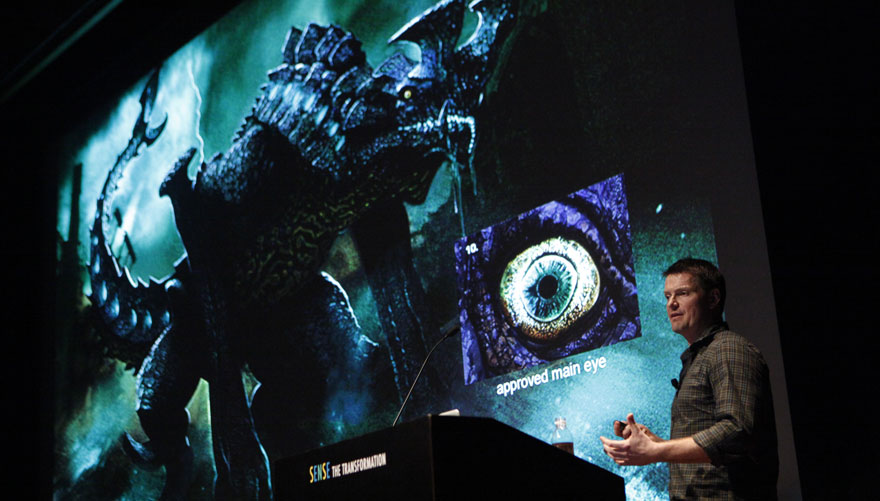
ILM VFX Supervisor Nigel Sumner describes the complex visual effects of "Pacific Rim" at SIGGRAPH Asia 2013. Image Copyright © SIGGRAPH Asia.

2014 marks the first year SIGGRAPH Asia will be hosted in Shenzhen. Given the burgeoning graphics industry in China, with recent government policies encouraging strong investment in animation, graphics and 3D technology, the conference is well placed. Nothing makes this clearer than Thursday's keynote speech by Digital Domain co-founder Scott Ross, entitled "Can Asia Become Hollywood?

The SIGGRAPH Asia 2014 Technical Papers program received a record-breaking 355 submissions. Of those, 63 papers were accepted, many of which reveal utterly groundbreaking advances in computer graphics and interactive techniques. Check out the video below for an eye-opening preview of some of the breakthroughs published at SIGGRAPH Asia 2014.

For many SIGGRAPH Asia attendees, the Emerging Technologies exhibit is their favorite part of the conference. This year, the E-Tech display showcases numerous mind-boggling technologies spanning the areas of virtual reality, augmented reality, robotics, wearable devices, 3D graphics, haptic devices and more. Take a look at some of the incredible advances on display in the preview video below.

In addition to leading-edge research, fascinating technologies and illuminating production talks, SIGGRAPH Asia 2014 also offers courses, workshops, business and technology symposiums, posters, master classes, and a world-class computer animation festival. Don't miss out on the excitement! Register for SIGGRAPH Asia 2014 today.


Mortadelo and Filemon Film to Screen at SIGGRAPH Asia

Mortadelo and Filemon Film to Screen at SIGGRAPH Asia

Mortadelo & Filemon is a beloved Spanish comic book series about the slapstick exploits of two secret agents in the TIA (Técnicos de Investigación Aeroterráquea, a spoof on the CIA). This year, the series has been adapted to a feature-length computer animated movie by Madrid-based Ilion Animation Studios. The film, entitled "Mortadelo & Filemon: Mission Implausible" (Mortadelo y Filemón contra Jimmy el Cachondo), will debut in theaters across Spain on November 28, but participants of SIGGRAPH Asia have the opportunity to attend a special screening of the film as part of the conference's Computer Animation Festival. The showing at SIGGRAPH Asia is the first time "Mortadelo & Filemon" will be screened in Asia.

In addition to a screening of "Mortadelo & Filemon," SIGGRAPH Asia 2014 offers attendees a rare glimpse behind the scenes of the film's production with a Featured Session entitled "Creating a quality featured animation from a renowned IP with budget constraints: "Mortadelo & Filemon: Mission Implausible."

Trailer for Mortadelo & Filemon: Misson Implausible

According to Javier Fesser, the film's director, "Mortadelo & Filemon" has a style that is neither photo-realistic nor traditionally animated. The intention behind this unique style is to convey the imperfections of a dirty world.

"Mortadelo & Filemon" is especially remarkable because of the budget constraints under which it was created. "We pushed the efficiency of the studio," said Fesser, "finding new workflows to produce stable shaders, writing custom software to reuse lighting between shots and a whole suite of animation tools for a streamlined production."

If you're planning to attend SIGGRAPH Asia 2014 and are interested in the "Mortadelo & Filemon" events, details are as follows:

Featured Session: Creating a quality featured animation from a renowned IP with budget constraints: "Mortadelo & Filemon: Mission Implausible"

Friday, December 5, 11:00 am – 12:45 pm
Bougainvillea Hall

Computer Animation Festival Special Screening: Mortadelo & Filemon: Mission Implausible

(English Subtitles)
Friday, December 5, 2:15 pm – 4:00 pm
Bougainvillea Hall

Registration for SIGGRAPH Asia 2014 closes on November 20. For more information on the "Mortadelo & Filemon" events at SIGGRAPH Asia, visit the Computer Animation Festival and Featured Sessions pages of the SIGGRAPH Asia 2014 website.

SIGGRAPH Asia Panels Explore the Evolution of Digital Art

SIGGRAPH Asia Panels Explore the Evolution of Digital Art

SIGGRAPH Asia is teaming up with the Digital Arts Community of ACM SIGGRAPH for the 2014 Conference in Shenhzen. On December 6, 2014, the SIGGRAPH Asia Featured Sessions program will include two digital arts panels to open the current discourse regarding future trends within artistic and multi-disciplinary practices. Under the general theme of "expanding the frontiers of digital arts," artists and theorists will gather for two discussions to explore the ongoing evolution of the field of digital art, and how it affects the changing nature of art making in an increasingly networked and computationally mediated world. The panels are:

New Boundaries for Digital Arts (11:00 – 12:45, Chrysanthemum Hall): What is digital art? What are the possibilities of emergent digital technologies, which enable us to push the boundaries of digital arts, creative media practice into popular cultures such as games design and computer animation?

Panel Members:

  • Jane Prophet, Professor, School of Creative Media City University of Hong Kong
  • Hanna Wirman, Research Assistant Professor, Hong Kong Polytechnic University, School of Design

Chair: Sue Gollifer, Director of the ISEA International Headquarters
Discussant: Atsushi Wakimoto

Digital Arts and Multi-Disciplinary Practice: The Artist in Science, History, and Cultural Studies (14:15 – 16:00, Chrysanthemum Hall): How do we open up the boundaries between interdisciplinarity and multi-disciplinary, research-focused arts and science environments to create new opportunities and pathways for collaboration and future exchanges within our own research practice?

Panel Members:

  • Maurice Benayoun, Professor, School of Creative Media City University of Hong Kong
  • Tian Shaoxu, Professor, School of Media and Communication Shenzhen University
  • Don Ritter, Professor, School of Creative Media City University of Hong Kong

For more information on the digital arts panels at SIGGRAPH Asia, visit the SIGGRAPH Asia 2014 website.

An Innovative Evolution of the Persistence of Vision Display

An Innovative Evolution of the Persistence of Vision Display

By Cody Welsh

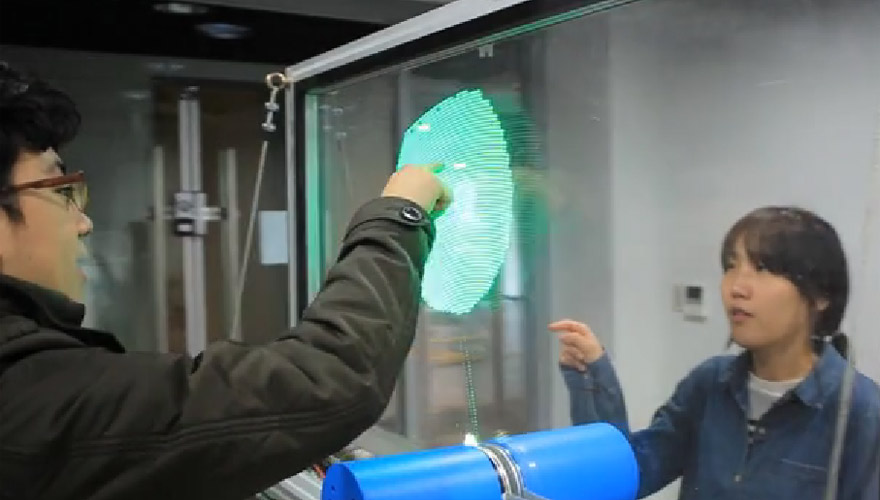
At one time, the most common scene that a persistence of vision (POV) display was associated with was, perhaps, in the rear window of a vehicle – for fun, rather than function. These displays rely on the “afterimage” that appears to persist in one’s vision; almost without exception, the design must include a rapidly oscillating or rotating linear array of LEDs, so as to take advantage of this property of the human eye and brain. For the most part, however, few individuals have ever thought to introduce the element of interactivity to these interesting “light-shows”. A project called JANUS is being developed by the Design Media and HCI labs of KAIST in Daejon, South Korea, and aims to expand upon both the functionality and practicality of these devices.

JANUS, which was exhibited in the Emerging Technologies program at SIGGRAPH 2014, not only solves an intrinsic problem with the design of POV displays, but also adds properties not commonly associated with them. For one, the fact that most of these displays only feature a single LED array facing towards one viewer is potentially problematic for anyone viewing the image from the other side – it will appear to be inverted. For this reason, KAIST’s project includes a secondary arm on the opposing side of the device, which allows for two viewers to observe either the same image from a correct perspective, or two entirely different images altogether – this could be a nice solution for the common difficulty that arises from any permutation of transparent display devices. In addition, the “blades” of the POV display in question contain ninety-six separate tri-color LEDs, so as to produce full-color images for both viewers.

The project’s teams did not stop there, however; a more interesting problem, perhaps, is that of interacting with these moving displays. Obviously, one could not just “touch” the image directly on the screen with the way that most implementations of the display already exist, at risk of injury (this project’s blades rotate at 1,000 RPM!). JANUS solves the problem of direct interaction by placing two sheets of plexiglass between the observer and the blade, and for purposes of manipulation, NEXIO ATI0500 infrared touch sensor frames. By utilizing this combination of various technologies, a new development emerges – one might even go so far as to say that it is “holographic” in nature, though JANUS does not necessarily adhere to that definition.

JANUS from Jay Lee on Vimeo.

Control interfaces included in the design of JANUS include only two separate components: a computer to receive the input from the touch sensor frames, and a Raspberry Pi to handle the image data. It is a fittingly simple scenario for a relatively simple – but innovative – device. According to the project specifications, the “blade” is currently set to display a single line of image data for every one degree of rotation that it traverses.

Although it is not a perfect solution to our desire for fully holographic displays, this advanced implementation of the age-old POV display is certainly a unique concept, and one can come up with plenty of interesting ideas to take advantage of it – the KAIST teams have experimented with image manipulation, particularly as it relates to an interaction between a user on one side of the screen to the other side; for instance, a variation on the universally recognized Snake was created to demonstrate the possibilities. From the SIGGRAPH 2014 Emerging Technologies paper, JANUS: “A player can control a snake and let it go through a hole [perceived in the screen]. A snake appears on the other side and the other player has to finish his/her mission to get the snake back to the previous side.”

It is easy to expand upon this unique idea of player-to-player interaction, and additional examples were provided of other concepts; clearly, there is reason to be interested in what JANUS leads to in time. These are the kinds of projects that may lead us to the future of display technologies.

Last Day for Early Bird Registration for ICAT-EGVE

Last Day for Early Bird Registration for ICAT-EGVE

October 31 is the last day for early bird registration for the joint conference ICAT-EGVE (the 24th International Conference on Artificial Reality and Telexistence, and the 20th Eurographics Symposium on Virtual Environments). The conference will take place in Bremen, Germany from December 8-10, and will be held in cooperation with ACM SIGGRAPH.

ICAT-EGVE presents a unique opportunity for researchers, developers, and users to share their knowledge of virtual reality, augmented reality, mixed reality and 3D user interfaces. According to the organizers of ICAT-EGVE, the Christmas fair in downtown Bremen will also be in full swing during the conference, and is a not-to-be-missed side attraction.

Members of Eurographics, EuroVR Association, VRSJ Japanese VR Society and ACM SIGGRAPH may register for ICAT-EGVE at the "member" rate. Early bird registration represents a savings of 100 € off the member and non-member rates.

More information on ICAT-EGVE from the conference organizers:

ICAT (the International Conference on Artificial Reality and Telexistence) started in 1991, and is the oldest international conference on Virtual Reality and Telexistence. Artificial Reality and Telexistence augment human ability in perception, understanding, action, time and space. They also enable humans seemingly to be everywhere at the same time, i.e., enable humans to be virtually ubiquitous. ICAT has been held in various cities around the world, including Tokyo, Taipei (2000), Seoul (2004), Christchurch (2005), Hanzhou (2006), Esbjerg (2007), Yokohama (2008), Lyon (2009), Adelaide (2010), Osaka (2011), Madrid (2012) and Tokyo (2013) again.
EGVE (the Eurographics International Symposium on Virtual Environments) is the Eurographics Symposium for the exchange of experience and knowledge among researchers and developers concerned with using and improving virtual reality. It started in 1993 as a workshop, and successful symposiums have recently been held in Zurich 2003, Grenoble 2004, Aalborg 2005, Lisbon 2006, Weimar 2007, Eindhoven 2008, Lyon 2009, Stuttgart 2010, Nottingham 2011, Madrid 2012, and Paris 2013.

For more information, or to register for the conference, visit the ICAT-EGVE 2014 website.