How Do You Animate an Emoji?

How Do You Animate an Emoji?

By Ian Failes. Republished with permission from Spark CG Society.

We’ve all probably sent emojis from our smart phones, in our emails, and in messaging apps. Now Sony Animation has taken us into the animated film world of the ubiquitous ideograms with Tony Leondis’ The Emoji Movie.

Behind the animation was Sony Pictures Imageworks out of its Vancouver and Los Angeles studios. We caught up with animation supervisor Sacha Kapijimpanga, who described the unique challenges of giving life to the many and varied emojis in the film.

These emojis at first appear to look quite simple in design, but as an animation supervisor, how do you jump on character designs and where did you look to add emotion and personality to these seemingly flat shapes?

Sacha Kapijimpanga: You’re right. These characters, out of any movie I’ve worked on, they’re super simple. They’re very basic in terms of design. How these characters are going to behave comes mostly from the performances of the actors and the casting. We had really good casting for this movie. Once we get the voices, we start doing kind of explorations in animations.

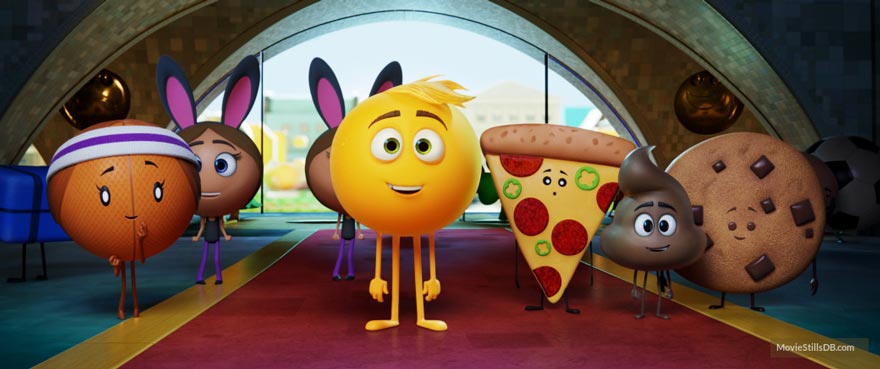
In terms of design, now, there isn’t a body, right? It’s basically a head with arms and legs. It’s really challenging to find poses that can convey what we’re trying to get across without all of these tools that we’re used to using, like the body posture. On these basic spheres we had the ability to slide the arms around, because he had a moving shoulder basically and moving hips that could connect anywhere in his body that helped us nail some poses down.
Still from The Emoji Movie

That was really challenging, but I think we overcame that and discovered ways to make them work really well. One of the really cool characters we had was Gene’s dad, Mel Meh, who was voiced by Steven Wright. He has a really super monotone type delivery. Once we got the voice for him, we started exploring ways he could move in a way that kind of worked with his voice.

We discovered that he has a really slow delivery, and really there’s not a lot going on in terms of inflexion and stuff like that. We tried different things like delaying his gestures to see if that would make something unique out of his character and try different things like dragging the gestures out, so he would be gesticulating with his arms. Even his gesticulations would go on for a little bit longer than you would typically animate, just to make him a little bit unusual.

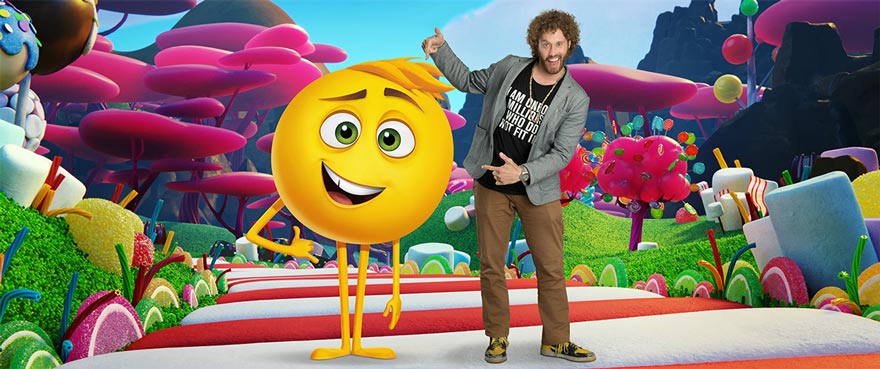
The Gene character is a ‘meh’ which means he’s not supposed to react very much to anything, but Gene actually does — what range of emotions did you have to deal with?

Kapijimpanga: Well, Tony set up this rule where we could stay within a certain range. So, for Smiler, for example, we had to stay within 10% to 15% of a smiling expression no matter what her delivery was. That was a tough thing to do, because even when you start getting into some of the tighter ‘O’ shapes and some of the smaller mouth shapes that you have to make to even just deliver dialogue, you’re starting to get off model with her a little bit. With the mehs, it’s the same kind of thing. You try to stay within 10% to 15% of being meh at all times. That’s the only thing that makes these characters kind of unique, in a way.
Still from The Emoji Movie

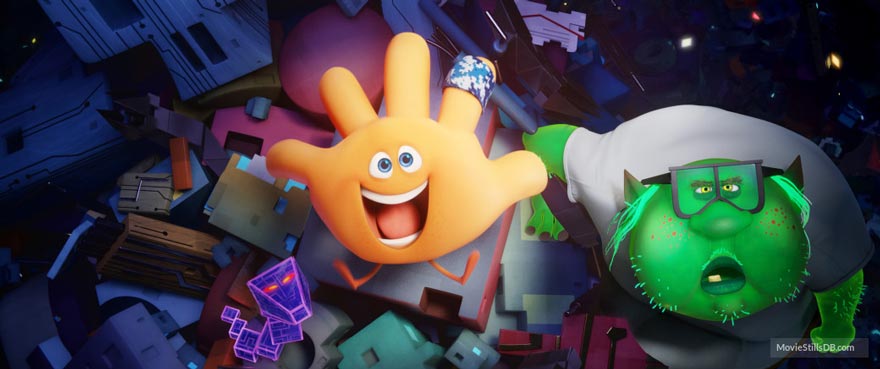
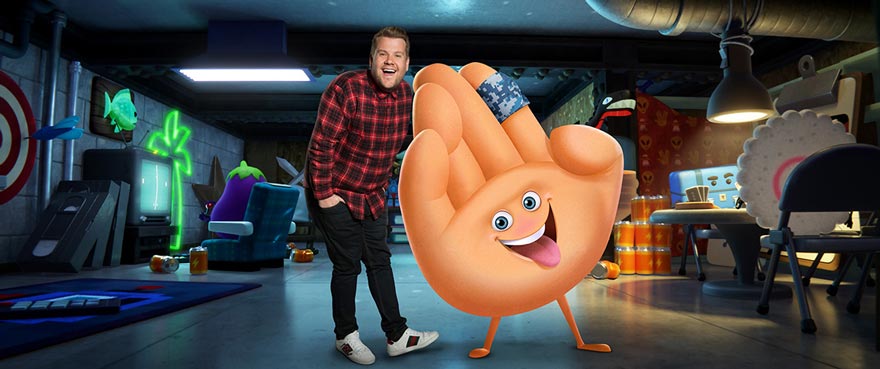
One character that really jumped out straight away was Hi-5, James Corden’s character. Here you had extra things you could animate, with the fingers, so how did you approach this character’s personality?

Kapijimpanga: He was one of my favorite characters actually in the movie. He was a big challenge at first, because Tony didn’t want to do too much squashing and stretching. He didn’t want to get too cartoony with our emotions in this movie. A lot of the storyboards for Hi-5 had him in kind of poses that felt like they were just a little bit more cartoony than the other characters. Like, he didn’t have arms, for example, so he used his pinky as an arm, and his thumb as an arm sometimes. Some of the poses we had to get into, we kind of just had to embrace the idea that we had to break his joints in his pinky to use that as an arm.
Still from The Emoji Movie

We had to embrace the idea that he was going to have to do that and not always look like a hand. Those challenges of turning that pinky into another arm kind of made him one of the most fun characters. Like some of the things the animators came up with were fantastic. I think he was a bit more pushed than some of the other characters, both because of James Corden’s performance, and just the design of the character forced us to be a little bit more cartoony with Hi-5. That was a lot of fun.

That’s interesting — you could go anywhere with having that much range of movement. Did you ever feel like you had to hold back?

Kapijimpanga: Initially, when we did some tests for the movie, we had all kinds of emojis that we were doing early tests with. We had a beer mug and some of the animation tests they did made it look more like there was liquid inside the mug as he was moving along. We also had some tests where we had an ice cream cone. We had a lot of squash and stretch in the ice cream as the ice cream was walking along. We were just doing some early kind of walk cycles to get things in front of Tony to see how he responded to things.

The rule he kind of established was that all of these characters, like the ice cream cone, for example, shouldn’t feel like ice cream in a cone. These were kind of plastic-y representations of characters. The beer mug, even thought it looks like a glass of beer, there’s no real beer inside. It’s an icon, so it’s not a liquid inside. We did all kinds of explorations for that stuff.

Can you talk about the face shapes and eyes and mouths? Did you investigate only having say a 2D face shapes approach at all?

Kapijimpanga: We did have fully 3D faces on the main characters, but we used 2D face shapes on some of the secondary and tertiary characters in the background. It was a design thing, because it was a simpler look for those characters, and sometimes they were further away, but also we were under serious time constraints on this movie as well. I think we have around 260 characters. Had we rigged all these characters with full 3D faces, it would’ve been impossible. We would never have gotten through the number of characters we had to.

They actually developed a system that used a 2D decal face rig, where we were basically animating almost 2D shapes on to the background characters. This worked really, really well. Then we would add a little bit more depth to them down the pipe. Then if a character ended up getting a slightly bigger part, then we can invest the time into making that a fully 3D character, but we tried to keep most of our development time and most of our rigging time into characters like Gene, who has full 3D faces, and a really, really broad range of movement.

Still from the Emoji Movie (Patrick Stewart)

This interview can’t finish without mentioning Poop, who’s voiced by Patrick Stewart. Did he have any unique challenges?

Kapijimpanga: All the animators who were interested in getting on the project were lured in by the idea of having Poop as a character you can animate. All of us has that in us, I guess — that inner child that just loves poop somehow. He’s a great character. Patrick Stewart’s voice was really fun to animate to. The idea was that he was a very proper kind of character who’s the butt of these jokes and he’s a little bit above all of that. He’s a really fun character to animate.

All images and clips copyright © 2017 Sony Pictures. All Rights Reserved.
Where to Find SIGGRAPH 2017 Papers and Other Content

Where to Find SIGGRAPH 2017 Papers and Other Content

SIGGRAPH is the world’s largest, most influential annual conference and exhibition in computer graphics and interactive techniques. Five days of research results, demos, educational sessions, art, screenings, and hands-on interactivity, and three days of commercial exhibits displaying the industry's latest advances.

Whether or not you'll be joining us at SIGGRAPH 2017, you can access much of the conference content online. It has been made publicly available by ACM SIGGRAPH as a service to the computer graphics community.


Downloadable Content

SIGGRAPH 2017 content includes technical papers, presentations, posters, course materials, videos and more. These materials can be accessed and downloaded a number of ways.

In the ACM Digital Library

The ACM Digital Library is a research, discovery and networking platform that contains the full-text collection of all ACM publications, including journals, conference proceedings, technical magazines, newsletters and books. SIGGRAPH 2017 content is available for free in the ACM Digital Library for a one-month period that began two weeks before the conference, and will end a week after it concludes. To locate SIGGRAPH content in the Digital Library, search for "SIGGRAPH 2017 [program name]" or "SIGGRAPH 2017."

Via Open Access Links

Beyond the "free access" period in the ACM Digital Library, ACM SIGGRAPH has made SIGGRAPH conference content available at no cost through special open access links on SIGGRAPH.org.

Conference Proceedings and Presentations USB Drives

USB drives of Conference Proceedings were available for pre-order until July 7. They are no longer available for purchase, but those attendees who did pre-order may pick them up in Los Angeles at Merchandise Pick-up.

USB drives of Conference Presentations can be ordered online in advance of the conference or at the conference itself. These drives will be delivered by mail approximately four weeks after the conclusion of the conference.


Streaming Video and Recordings

A number of SIGGRAPH 2017 sessions will be live-streamed on YouTube and Facebook. Visit the SIGGRAPH 2017 live-streaming page for more details.


Co-Located Event Content

Sponsored and co-sponsored conference content is freely available through open access links on SIGGRAPH.org.


Translated Content

Audio guides produced by the ACM SIGGRAPH International Resources Committee (IRC) provide translated descriptions of Emerging Technologies, Art Gallery, VR Village and Studio contributions — offering 8 to 10 different language options for each exhibit. Scan the QR code on each contributor’s sign and listen to the description of the work in another language.


On-Site Content for Attendees

When attendees check in at the Los Angeles Convention Center, they will each receive a booklet detailing the schedule of events at the conference. For the full SIGGRAPH experience, attendees should also download the official conference app and the ScavengerAR conference game (unless they don't like free swag and prizes).

The Conference App

The fastest way to identify the sessions, exhibits, presentations and events happening at the conference is to install the SIGGRAPH 2017 mobile app. The SIGGRAPH 2017 website even offers a handy guide for customizing your conference schedule based on your interests.

ScavengerAR Augmented Reality Conference Game

SIGGRAPH ScavengeAR is a mobile augmented reality game created just for SIGGRAPH 2017. The app is available for Android and Apple devices and can be played during the conference. Players will scan special markers to summon hidden creatures called “Sigglets” to unlock badges and earn rewards, such as SIGGRAPH merchandise and other surprises! You can download the app via the Apple App Store or Google Play Store.

SIGGRAPH 2017 will take place in Los Angeles, California, from July 30 to August 3.

Women in Computing: ACM SIGGRAPH Meets ACM-W

Women in Computing: ACM SIGGRAPH Meets ACM-W

By Aruquia Peixoto. Edited by Jessica Sommerville and Diana Arellano.

In mid-June, I traveled to NYC for the first time. The trip, however, was not for a vacation. Instead, I was fortunate enough to attend the Association for Computing Machinery's Council on Women in Computing (ACM-W). The ACM-W provides student scholarships, organizes Celebrations of Women in Computing, and has chapters all around the world. In order to participate in this association, all an ACM member needs to do is check the box for ACM-W when joining or renewing their ACM membership.

For quite some time, ACM-W and ACM SIGGRAPH have been trying to find the way to build a bridge between both organizations and create a synergy that could benefit both parts. Thanks to the work made by the ACM SIGGRAPH International Resources Committee (IRC) in highlighting the work of women in computing, this year ACM-W approached our committee to have one of its representatives as SIGGRAPH liaison in their yearly council meeting. As a member of the IRC, I was chosen to attend the council meeting in that role, with the intention of developing the opportunities for working together and expanding our activities through various channels.

Within the field of Computer Graphics, as well as in many other different industries, the number of women is far fewer when compared with the number of their male counterparts. This disparity only increases when we look towards the more technical areas and positions within Computer Graphics. As an assistant professor in a technical institution in Brazil, I have seen this over and over throughout the years. For this reason, we as a committee believe in the importance of opening a space and giving a voice to the ACM SIGGRAPH female community.

As a result, we (the IRC) at SIGGRAPH have organized the panel “Women in CG” since 2014. Last year we opened this space in SIGGRAPH Asia, where we held the session “Women in CG” and additionally “Girls in STEM”, the latter in collaboration with the SIGGRAPH Asia Symposium on Education. While the Women in CG meeting focuses on the questions of students that are entering the professional market, and also professionals that are developing a career, the Girls in STEM looks towards the young students that will enter the undergraduate courses in technical fields.

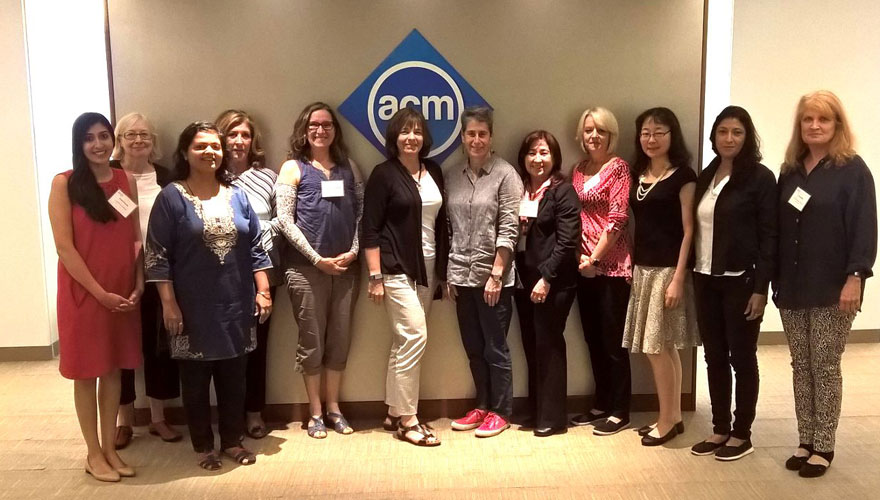
The ACM-W Council meeting took place at the ACM Headquarters in New York on July 15-16. The other invited participant was Julia Hirschberg, from the Computer Research Association Women (CRA-W). The ACM-W Council members participating in the meeting were Reyyan Ayfer (ACM-W Europe), Arati Dixit (ACM-W India), Priya Chawla (Student Leadership Training Project), Adriana Compagnoni (Scholarship Committee Chair), Wendy Powley (Celebrations Committee Chair), Z Sweedyk (Chapters Committee Vice Chair), Cindy Tucker (Community College Committee Chair), Melanie Wu (Communication Committee Chair), Jodi Tims (Vice Chair) and Valerie Barr (Chair).

The first day was dedicated to the reports of what was developed in the last year, where every council member reported their results. The two invited members were also invited to talk about their work. In my position as SIGGRAPH liaison, I reported on the meetings that have been held at SIGGRAPH and SIGGRAPH Asia. I also proposed that ACM-W should be present in the different SIG’s conferences through panels and workshops, making the connections among the women attending the conferences with ACM-W, and how those connections can be maintained when they come back to their institutions.

The second day was about what actions should be developed in the next year, and at the end of the meeting, the Vice Chair Jodi Tims and the Chair Valerie Barr invited me to be part of the ACM-W Council to develop the connections between ACM-W and the SIG’s Conferences. This is a real honor that only motivates me to continue my work with the IRC, ACM SIGGRAPH and the whole SIG community.

I would like to thank Valerie Barr for her support to the IRC in the past years, for opening the ACM-W doors to have an article published in their newsletter (you can read the article here), and for the warm welcome and support that she and her team gave me during the ACM-W Council Meeting. Also, thanks to Alain Chesnais (ACM past President, ACM SIGGRAPH past President, and long-time volunteer), Jeff Jortner (ACM SIGGRAPH President) and Barbara Helfer (ACM SIGGRAPH Communications and Membership Chair) for their support in connecting with ACM-W.

The ACM International Resources Committee (IRC) members involved in this article and in the “Women in CG” sessions are: Diana Arellano (IRC Chair), Aruquia Peixoto (IRC representative for Latin America, Africa and Middle East), Jessica Sommerville (IRC representative for Australasia), Suyin Bibliowicz (IRC representative for Asia) and Dolly Omisore (IRC representative for Europe).

This year's "Women in CG" panel at SIGGRAPH will take place on Tuesday, August 1 from 1:00 pm to 2:00 pm in the ACM SIGGRAPH Theater, South Lobby.

2017 ACM SIGGRAPH Award Winners Announced

2017 ACM SIGGRAPH Award Winners Announced

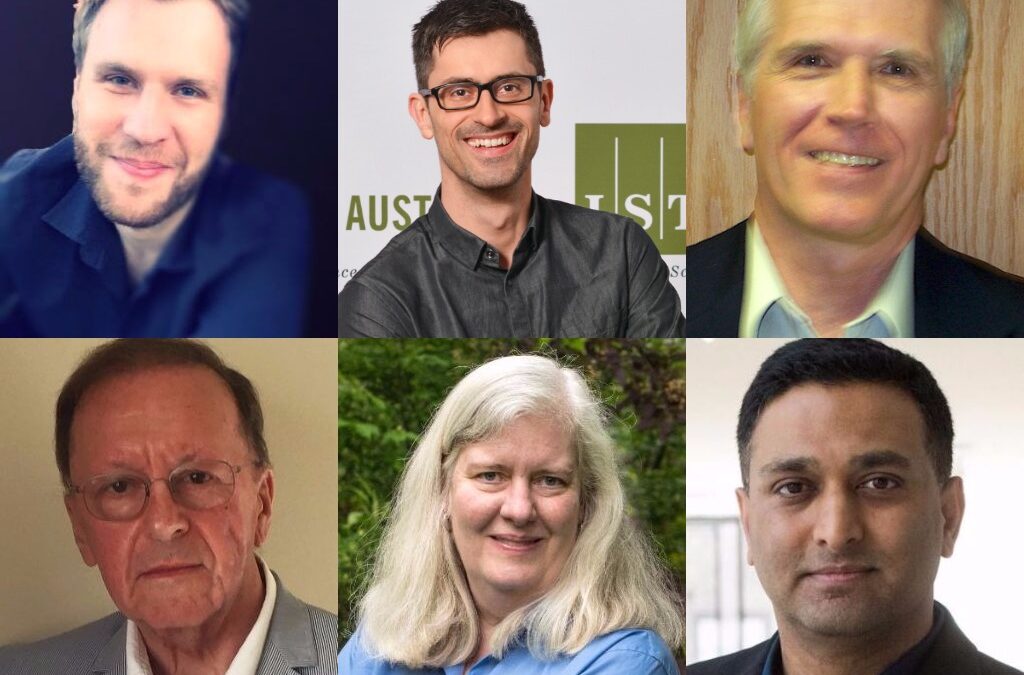
The ACM SIGGRAPH Awards program recognizes individuals who have made significant contributions to the computer graphics community through their research, teaching, service, or writing. This year, ACM SIGGRAPH will recognize six individuals whose impressive achievements have more than earned them the awards they'll accept onstage at SIGGRAPH 2017. In addition to the six award winners, ACM SIGGRAPH will recognize two honorable mentions for the Outstanding Doctoral Dissertation Award.


The Steven Anson Coons Award for Outstanding Creative Contributions to Computer Graphics

Jessica HodginsRecipient: Jessica Hodgins

The Steven A. Coons award is presented in odd-numbered years to honor an individual who has made a lifetime contribution to computer graphics and interactive techniques. Selected as this year’s recipient in recognition of her foundational work in character animation, her support and cultivation of emerging researchers, and her extensive volunteer service to the computer graphics community, Hodgins exemplifies the type of leadership and career-spanning achievement the Coons Award was created to honor.

Read the full press release.


The Computer Graphics Achievement Award

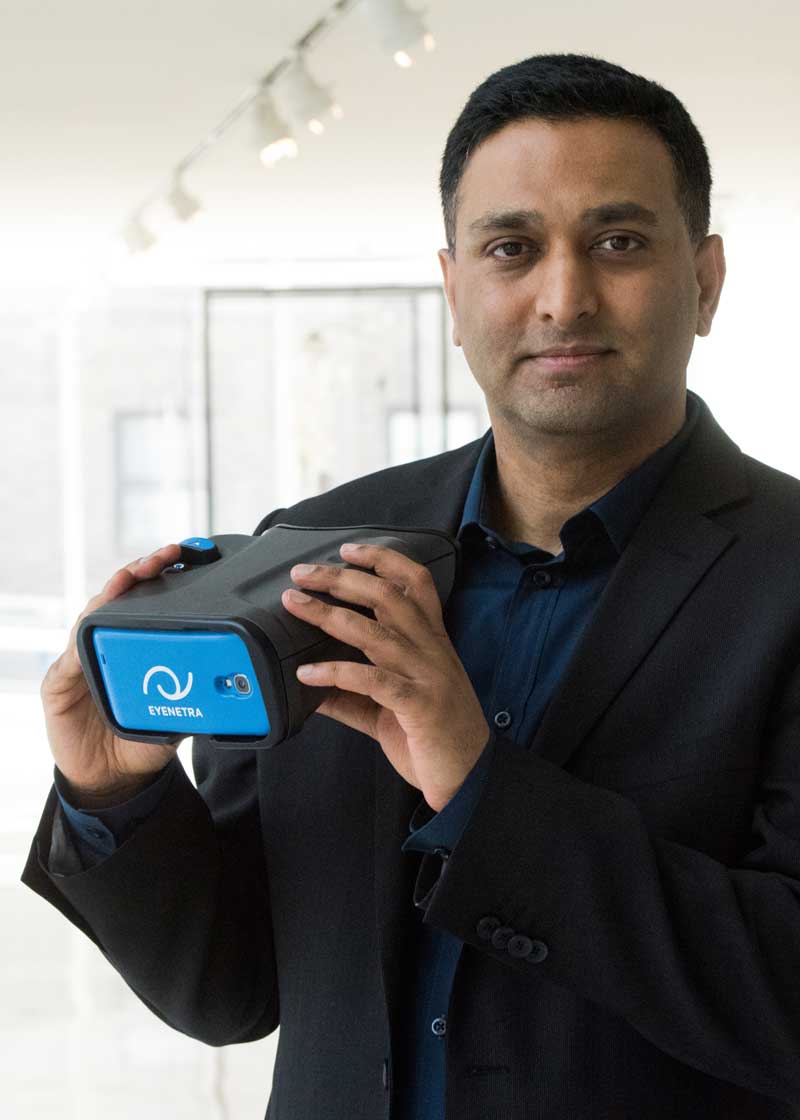
Recipient: Ramesh RaskarRamesh Raskar

The Computer Graphics Achievement award is given each year to recognize an individual for an outstanding achievement in computer graphics and interactive techniques. Selected as this year's recipient in recognition of his numerous, impactful research contributions in computational imaging and light transport, Ramesh has advanced the field in a wide variety of areas, including femto-photography, light-field displays, and augmented reality.

Read the full press release.


The Significant New Researcher Award

Recipient: Bernd BickelBernd Bickel

The Significant New Researcher Award is awarded annually to a researcher who has made a recent, significant contribution to the field of computer graphics and is new to the field. The intent is to recognize people who have already made a notable contribution very early in their careers and are likely to make more. Selected as this year's winner for his work in computational fabrication and in facial modeling and animation, Bernd Bickel is an Assistant Professor at IST Austria. Bernd's research spans multiple disciplines that include material science, biomechanics, fabrication, and animation. Before starting at IST Austria, Bernd received his master's and PhD from ETH Zurich, and worked as a research scientist at Disney Research Zurich.

Read the full press release.


The Outstanding Doctoral Dissertation Award

Recipient: Felix HeideFelix Heide

The Doctoral Dissertation Award is awarded annually to recognize a recent doctoral candidate who has successfully defended and completed his or her Ph.D. dissertation in computer graphics and interactive techniques. This award recognizes young researchers who have already made a notable contribution very early during their doctoral study. Selected as this year’s recipient for his remarkable work in computational imaging and display, Felix Heide received his PhD in December 2016 at the University of British Columbia under the advisement of Professor Wolfgang Heidrich. Much of his research has focused on revolutionizing imaging and display technologies through computation; enabling faster, less expensive, and more portable display devices. He has co-authored more than 20 publications on this area of inquiry and related topics.

Read the full press release.

Honorable Mention: Myers Abraham (Abe) Davis, Massachusetts Institute of Technology

Selected for his exceptional doctoral dissertation on extracting information from tiny invisible movements in video, reconstructing sound, inferring physical properties, and synthesizing new motion.

Honorable Mention: Matthew O’Toole, University of Toronto

Selected for his outstanding doctoral dissertation on computational cameras and matrix algorithms for efficient optical-domain light transport analysis and robust 3D imaging of complex scenes.


The Outstanding Service Award

Recipient: Alyn RockwoodAlyn Rockwood

The Outstanding Service Award is presented annually to recognize a career of outstanding service to ACM SIGGRAPH by a volunteer. It recognizes an individual who has given extraordinary service to ACM SIGGRAPH, both in the trenches and in positions of more responsibility or visibility, over a significant period of time. Selected as this year’s recipient for his long-term and significant contributions to both the ACM SIGGRAPH organization and its conferences, Alyn Rockwood was the SIGGRAPH 2003 Conference Chair, served as ACM SIGGRAPH Vice President from 2006 to 2009, and headed the steering committee that orchestrated the launch of the SIGGRAPH Asia conference. Equally fascinated by art and science, Alyn has regularly contributed to both conferences over the decades, with accepted submissions to a wide variety of programs that include the Computer Animation Festival, the Art Show, Emerging Technologies, Papers, Courses, Sketches, and the Educators Program.

Read the full press release.


The Distinguished Artist Award for Lifetime Achievement in Digital Art

Recipient: Ernest EdmondsErnest Edmonds

The Distinguished Artist Award is presented annually to an artist who has created a substantial and important body of work that significantly advances aesthetic content in the field of digital art. Selected as this year’s recipient for his major contributions to the development of computational art and to the broader field of contemporary art from the late 1960s, Ernest Edmonds has created work that represents an important landmark in the field of generative and interactive art. By applying color theory, computational logic and programmed systems to his work, he brought together the structural research of Biederman and the Constructivists for the first time, and took them to a new previously unexplored level that encompasses the notion of time, color and structure. Ernest is also an international expert on human-computer interaction who specializes in creative technologies for creative uses.

Read the full press release.


SIGGRAPH 2017 Party Calendar

SIGGRAPH 2017 Party Calendar

In search of a list of after-hours events at SIGGRAPH 2017? Maybe we can help.

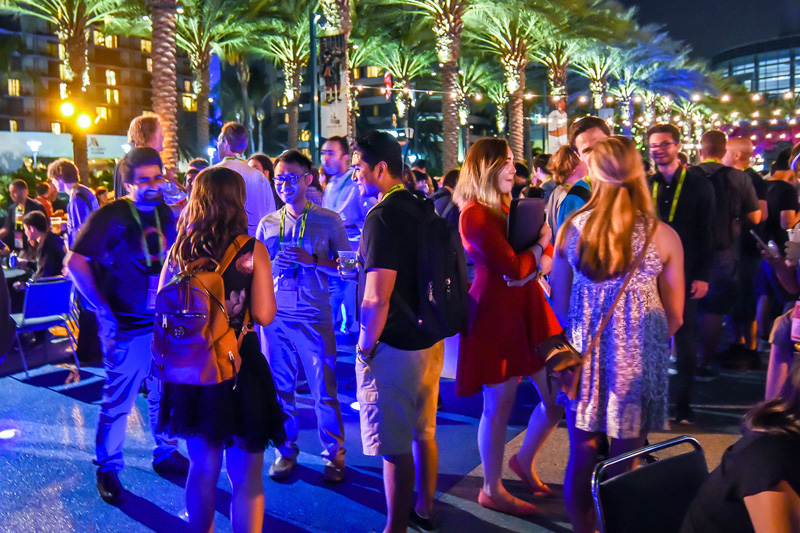
SIGGRAPH.org has compiled a calendar of public parties and events at SIGGRAPH 2017 (also embedded below), which will be updated as information becomes available. To import the party listings to your Google calendar, click the +Google Calendar button on the lower right of the calendar, or add events individually by clicking on the event names. If you're hosting a public party or event at SIGGRAPH 2017 and would like it to appear on this calendar, please contact the ACM SIGGRAPH Content Manager.

Note that this is an unofficial calendar, so it's possible that actual event times and locations may differ from those listed. Be sure to double check with the conference locator or sponsoring organization.

Also please note that many of these events are not directly affiliated with ACM SIGGRAPH or the conference, though they are put on for the benefit of SIGGRAPH attendees. ACM SIGGRAPH is providing this information as a courtesy to conference attendees, and does not necessarily recommend or endorse any of the events or the sponsoring companies or organizations.