June 20: Last Day for SIGGRAPH 2014 Early Reg Discount!

June 20: Last Day for SIGGRAPH 2014 Early Reg Discount!

June 20, 2014 is the last day to register for SIGGRAPH 2014 with the advance registration discount! 

In addition to the early bird discount, SIGGRAPH is also offering a steeply discounted registration to unemployed ACM SIGGRAPH members. A full list of registration fees can be found on the SIGGRAPH 2014 website.

Looking for reasons to attend SIGGRAPH 2014?

How about the bevy of cutting-edge computer graphics courses, taught by highly respected instructors?

Or the Emerging Technologies exhibit?

And don't forget the Computer Animation Festival!

SIGGRAPH 2014 is on target to be one of the most exciting, activity-packed SIGGRAPH conferences yet — so don't miss out!

Register for SIGGRAPH 2014 now.

SIGGRAPH Introduces Students to the Wonder of Computing

SIGGRAPH Introduces Students to the Wonder of Computing

According to a survey conducted by the U.S. Bureau of Labor Statistics, computer science is one of the country's fastest growing occupational fields. By 2020, the BLS estimates there will be 4.2 million computing and IT jobs in the United States alone. A recent talent strategy report from Microsoft seems to corroborate the BLS' survey results; the report states that in 2012, Microsoft was left with 3,400 unfilled research, development and engineering positions — a 34 percent increase in empty chairs from the year prior. 

Despite the exploding demand for workers skilled in computing, American high school students often graduate with minimal exposure to the near-limitless potential of the art and science of computing. Though the demand for computer-savvy workers is tremendous and steadily increasing, less than 10 percent of the high schools in the United States actually offer students an AP computer science course. The increase in computing jobs is not limited to the U.S., however; nor is the U.S. the furthest behind in computing education. Young students all over the world could benefit from greater exposure to computer science and technology.

Since 2003, the ACM SIGGRAPH Computer Graphics Pioneers group, the ACM SIGGRAPH Education Committee, and various sponsors have been working to introduce high school juniors and seniors to the scientific, artistic and career possibilities offered by the field of computer graphics. The program, dubbed "Spend a Week at SIGGRAPH," provides a limited number of high school students — aged 16 or over, who live in or near the city that hosts SIGGRAPH — unrestricted access to the conference; a full week of immersion in cutting-edge computer graphics technology, art and research.

Without exception, each year of the program has proven a resounding success. In thank-you letters to mentors, student after student has repeated the words "overwhelming,"  "life-changing" and "amazing." There's little doubt that the "Spend a Week at SIGGRAPH" program has touched the lives of hundreds of young people, opened their eyes to new career paths and, perhaps, even changed the trajectory of their lives.

ACM SIGGRAPH is currently seeking mentors and students for this year's program.

Volunteer as a SIGGRAPH mentor: Mentors spend an average of 30 minutes per day with their student, providing on-site schedule guidance and advice. If you are planning on attending the 2014 SIGGRAPH conference in Vancouver, Canada, and would like to volunteer to serve as a mentor, please contact the chief student mentor by email. 

Nominate a student: If you are a high school educator in the Vancouver area who would like to nominate one or more students for this program, please contact the chief student mentor for more information.

Apply to attend SIGGRAPH: If you are a high school student in the Vancouver area (aged 16 or older) and would like to participate in the program, please contact the chief student mentor for further information and details on how to apply.

Learn more about the "Spend a Week at SIGGRAPH" program and read thank-you letters from past participants.

Find out what you can expect to see and experience at SIGGRAPH 2014.

Watch the video below for interviews with participants in the 2011 "Spend a Week at SIGGRAPH" in Vancouver, Canada.

SIGGRAPH 2014 Technical Papers Preview

SIGGRAPH 2014 Technical Papers Preview

The SIGGRAPH Technical Papers preview is now available! The premier international forum for disseminating new scholarly work in computer graphics and interactive techniques, the SIGGRAPH Technical Papers program covers a wide variety of topics, including modeling, animation, rendering, imaging, human-computer interaction, computer games, scientific visualization, information visualization, computer-aided design, computer vision, audio, robotics and fabrication.

SIGGRAPH 2014 will take place in Vancouver, Canada, August 10-14. Early-bird registration discounts are available until June 20. Visit the SIGGRAPH 2014 website for more information.

The Future Looks Bright for Augmented Reality

The Future Looks Bright for Augmented Reality

By Pritham Marupaka

With the advent of social networks, smartphones and increasingly powerful web services, our digital existence has grown immensely in recent years. From shopping to attending a conference call, technology enables us to connect with the people and resources we need in a matter of seconds. Though we’re more connected than ever before, there has always been a line between our virtual presence and our real existence. Augmented reality (AR) technology aims to blur that line, if not erase it completely.

When working as designed, augmented reality merges the real and digital worlds by superimposing virtual information onto everyday objects. Google Glass is a prominent example of an augmented reality device, with potential applications in numerous areas, including medicine, education and the military.

Over the last few years, augmented reality technology has shown significant growth. Global market research firm MarketsandMarkets’ March 2014 report “Augmented Reality & Virtual Reality Market“ predicts the Compound Annual Growth Rate of AR at around 15% — making augmented reality a $1 billion market by 2018.

One of the more popular applications of AR is interactive advertising. UK-based start-up Blippar, for example, utilizes AR technology to augment print media. Users with Blippar-enable smartphones can point their cameras toward supported advertisements to see previously hidden interactive content (video, text and images). Even in today’s ad-saturated culture, Blippar has been downloaded more than 4.7 million times.

Augmented reality marketing appeals to some advertisers for such its ability to captivate people and increase the exposure to their products. Data gathered by Blippar shows that people engage with an advertisement for four and a half minutes on average, significantly higher than traditional print, internet or television marketing. Research done by UK-based augmented reality firm Hidden Ltd reveals that the likelihood of a parent to buy a toy when advertised with augmented reality is 29% higher than when advertised with 2D print advertisements.

Beyond marketing, AR systems are applicable in various other fields. Engineers at the Battlefield Air Targeting Man-Aided (K)nowledge lab (BATMAN) are leveraging Google Glass technology to improve communication within the Air Force. Augmented reality applications enable pilots and air traffic controllers to acquire increased situational awareness and instant updates without losing track of their immediate tasks; the use of AR technology here is highly pragmatic, addressing a vital issue.

The technology is also quickly spreading to the educational sphere, as augmented education apps enable students to become more actively involved in the lessons. Education blogger Todd Nesloney, a fifth grade Texan school teacher, notes that, “Educators know that learning deepens, not just through reading and listening, but also through creating and interacting. With augmented reality products … students manipulate and combine elements … right from their Android or iOS devices, rather than just reading about them in a textbook.” Aurasma, the augmented reality development arm of Hewlett Packard, identifies twenty percent of its users as educators or students, which makes it clear that we can expect to see more augmented reality applications enriching students’ education in the years to come.

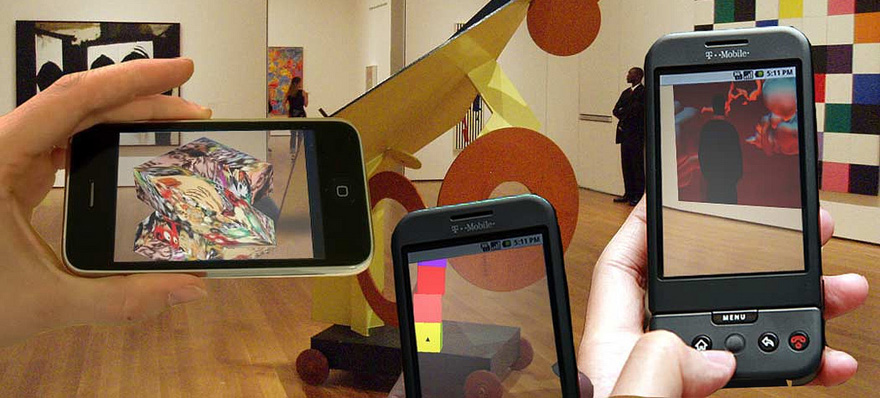
WWF augmented reality polar bear experience at the Science Museum in London.

There are a few issues to be addressed regarding augmented reality before it can move forward and increase its impact on day to day lives. The first is the current state of AR technology. Though it has developed greatly from its inception, the applications still need a lot of work to be thorough and accurate. Technological limitations in computer vision and image processing are some of the factors that need to be improved for better AR devices. Privacy concerns must also be taken into consideration. With the immense amount of data to be collected through AR devices and stored into corporate databases, certain data governance regulations must be set in place to ensure consumers feel safe using the applications.

There is no doubt that augmented reality has a bright future and the potential to greatly impact everyday transactions and interactions. More companies and organizations are beginning to embrace this alternative to traditional media and there is greater academic involvement in the field given its vast utility. Moving forward, it is expected that AR devices will play an integral role in educational, military and industrial settings. Privacy and security concerns, however, must be considered with the advancement and dissemination of augmented reality technology.

Image Attribution: "DIY Augmented Reality, MoMA NY" by sndrv is licensed under CC BY 2.0 / Cropped from original
SIGGRAPH 2014 Offers Registration Discount to Unemployed

SIGGRAPH 2014 Offers Registration Discount to Unemployed

The current economic situation has made it difficult for people in many professions to find jobs. The computer graphics community is no exception. While the annual SIGGRAPH conference is rife with opportunities for networking and locating job openings in computer graphics, unemployed job seekers are typically in financial flux — and as a result, may have difficulty affording the cost of registration. SIGGRAPH believes that in these times, it’s especially important that members of the SIGGRAPH community continue to come together to make connections, provide mutual inspiration, and continue to look forward and help create the future. In recognition of the fact that unemployed members of the computer graphics community may not have the financial means to attend SIGGRAPH 2014 without help, SIGGRAPH has decided to extend the lowest possible registration rates (the same as Student Member rates) to unemployed attendees. SIGGRAPH 2014 full conference registration rates are as follows*:
  • $945: ACM or ACM SIGGRAPH Member
  • $1,145: Non-Member
  • $395: Student Member or unemployed Member of ACM or ACM SIGGRAPH
Click here to register online with the unemployment discount.

SIGGRAPH 2014 Details:

  • Conference: The 41st International Conference and Exhibition on Computer Graphics and Interactive Techniques
  • Dates: 10-14 August (conference), 12-14 August (exhibition)
  • Location: Vancouver Convention Centre, Vancouver, Canada
Reasons to attend SIGGRAPH 2014 To take advantage of this discount, you must be a member of ACM or ACM SIGGRAPH and agree to the terms listed on the SIGGRAPH 2014 website. Though eligible individuals will receive discounted rates on conference registration, all other costs such as travel, lodging, and incidentals are not covered in this program and are the responsibility of the individual. SIGGRAPH has negotiated discounted hotel rates for SIGGRAPH 2014 attendees. To secure these discounted rates, reserve your SIGGRAPH 2014 hotel room through the conference website. Not sure if you need a visa to attend SIGGRAPH 2014? The SIGGRAPH International Resources Committee has created an interactive tool to help you find out. *All pricing reflective of registrations executed on or before 20 June.