2015 ACM SIGGRAPH Election Results Announced

2015 ACM SIGGRAPH Election Results Announced

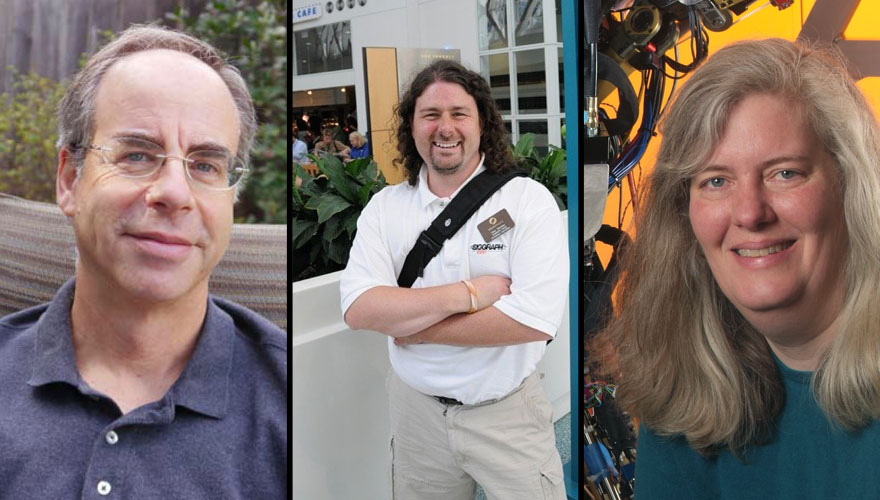
The 2015 ACM SIGGRAPH election results have been announced. Paul Strauss will join the ACM SIGGRAPH Executive Committee as a director-at-large, Dave Shreiner will take over as treasurer and Jessica Hodgins will begin a second term as one of the organization's six directors-at-large. All three will serve three-year terms, beginning on July 1, 2015.

Each of these individuals has been involved with ACM SIGGRAPH and its conferences for a substantial period of time. Paul Strauss, a software engineer who specializes in 3D computer graphics, has attended every SIGGRAPH conference since 1984. In addition to serving as a SIGGRAPH unified juror on multiple occasions, Paul was the courses chair for SIGGRAPH 2013.

Dave Shreiner is an expert in computer graphics and GPU computing, specifically, rendering with OpenGL, and has authored several books and courses on the subject. In 2014, Dave served as the SIGGRAPH conference chair, leading a team of volunteers and staff to orchestrate the 41st occurrence of the world's largest conference on computer graphics, which was an extremely well-received conference.

Jessica Hodgins is a professor in the Robotics Institute and Computer Science Department at Carnegie Mellon University, and VP of Disney Research. Among her many achievements, Jessica has served as editor-in-chief of ACM Transactions on Graphics (2000-2002), was the SIGGRAPH 2003 papers chair, served as the SIGGRAPH 2007 panels chair, and was awarded the ACM SIGGRAPH Computer Graphics Achievement Award in 2010.

ACM SIGGRAPH warmly welcomes Paul, Dave and Jessica to the Executive Committee, where their expertise and passion will help guide the organization on its mission to foster and celebrate innovation in computer graphics and interctive techniques.

Please join us at SIGGRAPH 2015 in Los Angeles, from August 9-13.
Get to Know Our Chapters: Tehran ACM SIGGRAPH

Get to Know Our Chapters: Tehran ACM SIGGRAPH

The Tehran Chapter of ACM SIGGRAPH was formed a little more than a year ago. In the intervening months, it has grown into one of the organization's most active chapters, amassing more than 400 members and hosting nearly a dozen successful events.

In an effort to learn more about the chapter, and discover the secret behind its breakneck growth and continued success, we sat down for a chat with Tehran ACM SIGGRAPH Chair Amirhossein Erfani.

Why do you think it's important to have an ACM SIGGRAPH chapter in Tehran?

As a founder and the leader of a very active computer graphics community in Iran, I always dreamed about showing the world the talent of Persian digital artists. We managed to participate in SIGGRAPH Asia three years in a row, which proved to me and other fellows that our society of computer graphics experts and digital artists was capable of handling the next level: an ACM SIGGRAPH Professional Chapter. After many weeks of research and development, we finally managed to found our chapter in May of 2014. Now, after a year, it's obvious that the chapter is really making a difference. I consider this a perfect beginning to do some more prestigious events for this awesome community.

Tell me about one of your favorite chapter events so far.

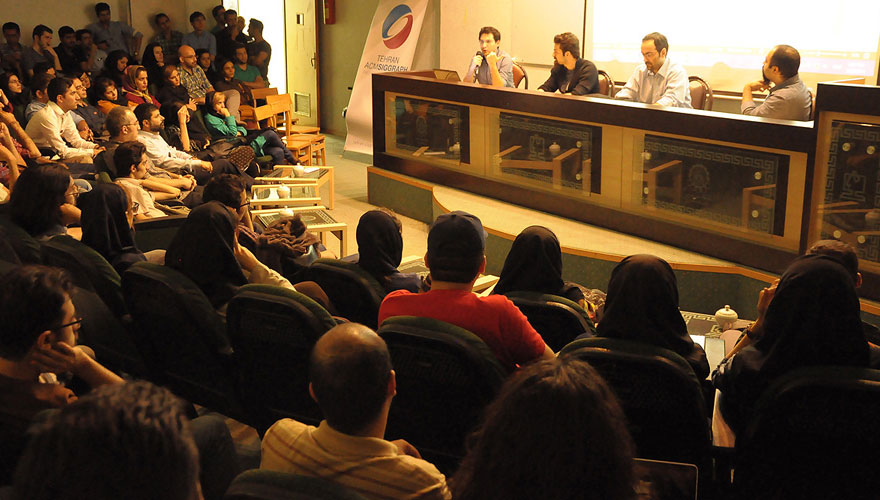
Our "Post-SIGGRAPH 2014" event at Tehran University was really a blast! More important than being a chapter event, it was an introduction to SIGGRAPH for many attendees, which really helped us planning more professional events for the professional subset of our audience. One of the sweetest parts of this event was the video message we received from Paul Debevec, who is a serious source of inspiration for us.

Have you made friends through the chapter?

Sure! Not only me, but everybody's finding everybody in every single event! That's the very first advantage of a professional community, that people have this great opportunity to meet each other and boost the productivity.

How did you personally get involved with computer graphics?

I can easily remember how amazed I was when I watched "Toy Story" for the first time, at the age of nine. Later, by reviewing the magic of George Lucas' "Star Wars," I was sure that I want to do something in my life that related to 3D! I started learning 3D Studio Max 2.0 when I was 14, and continued my way until now. As a 3D vehicle artist, the "Need For Speed: Most Wanted" video game really influenced my career, especially when I found out that Habib Zargarpour was the art director of the game. A well-known VFX artist and Academy Award nominee, Habib is a compatriot and a friend who helped me a lot. He also told me what the big CG event "SIGGRAPH" was all about, years ago! These series of events really changed my life, and made me want to do something that I really want to do, and at the same time — something that counts.

What are your short-term and long-term goals for the chapter?

Our short-term goal is to keep organizing important and valuable events based on the proposals we receive from the talented individuals. Also, we have a resolution for our second year which is, hopefully, adding a multi-session computer graphics course to university programs for computer engineering and computer science majors, as well as art majors in art universities. We have arranged the essentials for this purpose, and it's great to know that Tehran's biggest universities are really passionate about it. If this idea happens in near future, then we can really be proud of ourselves — starting a CG movement in academia.

Our long-term goal is to make our moves more international! Like inviting great people to our city and universities and develop the interactions at its best way possible. Also, organizing more international events, with helps from other chapters and other passionate people who I've met, a lot of them from the awesome ACM SIGGRAPH family. I believe that the future of computer graphics in Tehran (and Iran) really depends on the moves we make these days, so we should act carefully while remaining smart and hopeful.

Tehran ACM SIGGRAPH Event

Your chapter has experienced tremendous growth and success almost immediately. Do you have any words of wisdom to share with others looking to start an ACM SIGGRAPH chapter in their city?

Thanks! Well, as Einstein says, "imagination is more important than knowledge" — try to imagine the future at its best, and then make it happen with ALL your passion and enthusiasm! Personally, I have experienced the great feeling of doing something that changes people lives, and that's the beauty of forming and developing a community. I see it this way — I never wanted to be just another artist, I wanted to do something that other people could benefit from as well. This, I'll remember and honor for the rest of my life. Also — choose your chapter officers wisely, one of the most important reasons we manage to do great stuff is that our main officers (Amirhossein Fassihi, Yaser Zhian and Mehrdad Ashtiani) are really the best in industry, as well as our team and our Board of Directors.
Last, but not least, the main reason for our success is ACM SIGGRAPH itself. I have never seen such a dynamic, alive, friendly and professional community in my life. When you are part of this awesome family, you automatically inherit the right genes to be awesome!

Tehran ACM SIGGRAPH Chapter Facts:

  • Current Membership: 420
  • Past Events:
    • Official establishment/opening ceremony
    • Post-SIGGRAPH 2014
    • VFX talk on movie compositing
    • Augmented reality and virtual reality talk
    • Post-mortem of "ET Armies" video game
    • Parametric animation seminar
    • An introduction to look development and using physical shaders in 3Delight
    • HFSM structure and applications in game development
    • Oculus Rift : Virtual Reality in Past, Present and Future
    • Tehran playback of It's Art Master Classes
  • Upcoming Events:
    • Tehran V-Ray Day
    • Tehran Animation Festival (Local screening of short animations of Persian animators/companies)
    • Free (mostly introductory) computer graphics courses at the Universities of Tehran, Sharif, Amirkabir, Elm-o-sanaat
    • More panels, workshops, post mortem talks and presentations

For more information, visit the Tehran ACM SIGGRAPH Professional Chapter website.

To learn more about joining an ACM SIGGRAPH chapter in your area, or forming your own local chapter, visit the ACM SIGGRAPH chapters page of SIGGRAPH.org.

هدف از این فصل است که برای اتصال جامعه گرافیک کامپیوتری در تهران به طوری که آنها می توانند از دانش و تجربه یکدیگر بهره مند شوند. برای اطلاعات بیشتر، به وب سایت تهران ACM SIGGRAPH بروید.

SIGGRAPH Trailer Competition Announced

SIGGRAPH Trailer Competition Announced

The SIGGRAPH Education Committee has announced a new competition for SIGGRAPH 2015: The SIGGRAPH Trailer Contest.

Students are invited to create a 10 to 60 second trailer that captures the excitement and wonder of the SIGGRAPH conference. The winning trailer may be screened at the conference (which is attended by tens of thousands of computer graphics professionals, including the heads of many major CG studios), and posted online for general public viewing. Students are encouraged to be creative in their submissions. SIGGRAPH 2015 logos may be incorporated into entries (provided they follow ACM SIGGRAPH's logo use policy), but students are free to use their imaginations to tell a unique story about SIGGRAPH.

Mediums used for entries can be computer-generated 2D, 3D, live action composites, stop motion or experimental techniques. A panel of judges assembled by the SIGGRAPH Education Committee will vote on and decide the winner. The grand prize winner will receive a full conference registration to attend SIGGRAPH 2015 in Los Angeles, where he or she will be recognized for their winning entry (please note, travel and lodging are not included).

The majority of the work in any entry must be created by current students. Applicants must be full-time students in high school, undergraduate, or graduate school or enrolled full time for at least one semester during the 2014-2015 academic year (summer 2014 – spring 2015).

For the full contest rules and submission instructions, visit the SIGGRAPH Trailer Contest page of the ACM SIGGRAPH Education Committee website. Please send any questions to trailercontest@siggraph.org.

Need inspiration? Check out FMX 2014's trailer, Rugbybugs, which was created by a team of students from Filmakademie Baden-Württemberg.

Demo Reel Advice for CG, VFX and Animation Students

Demo Reel Advice for CG, VFX and Animation Students

By Cody Welsh

If you’re an aspiring computer graphics artist, you’ve probably discovered how important it is to have a reel that makes you stand out from the crowd. The concept is simple enough to grasp, but actually creating a reel that best showcases your — undoubtedly amazing — creations is no easy feat, especially with the amount of competition that exists for jobs in computer graphics, animation and visual effects. To help you figure out how to make your reel the best it can be, we contacted three people who have a tremendous amount of experience in the matter, and asked them to give it to us straight. What makes a good reel?


Expert #1: Vince De Quattro

  • Head of Production at Athena Studios
  • Veteran VFX artist
  • Former master's-level instructor of visual effects
  • Worked at Industrial Light & Magic
  • Has been vetting reels for almost 20 years

1. It should be interesting. Editing is key. One mediocre inclusion blows the entire reel. Shorter reels are less likely to include sub-par entries. Best material first. Don't split material from single projects over the reel. I hate that. Include only the best two to three shots from a single collaborative or longer piece. Don't keep hitting me over the head with like material from the same project. I get it. Now move on. I'm losing interest.

2. Choose collaborative pieces over single exercise stuff. I want to know that you can work within a complex pipeline. Let your reel index explain how you operated within the collaboration. The better the collaboration, the better for you. Even bad collaborations or small indie projects can produce some beautiful shots, creatures creatures and/or concepts. Be open to working for collaborations in school, especially cross collaborations in other departments like film, advertising, new media, industrial design, architecture and sculpture. If you're a digital artist, try to get into working with the traditional animation teams. Learn both sides. If you're a modeler, be sure to take anatomy classes — both human, and animal.

3. If you can draw/paint/sculpt, include it in your reel. In fact, if you can create concept art for your material (like a concept for a creature model), please include it as part of your turns/breakdowns. If you're a modeler, please include ecorche (skinless figure study) materials. Again, if you're not good, do not include them. Bad fine arts material doesn't help.

4. If you're an animator, make sure you're using an extensible rig. There are a million Norman and Andy mods. Please don't use vanilla Norman or Andy. Make sure that your monologue/dialogues are interesting and tell stories. It's ok to rip tracks to run with, but make sure they are not offensive, stupid or banal. Don't show guns. Don't show murder. Don't animate anything that any of the top three animation studios wouldn't show at a G screen. Seriously. You can do your dark opus later, after you retire. Right now you want to get a collab position at a major. Don't offend us.

5. If you're a modeler, make sure you include at least one "moment in time" turntable. A "moment in time" turntable is a large scene that depicts a frozen moment in time, capturing emotion and motion between several different actors/actresses, and bonus for anthropomorphic inclusion like a bird or other quad. Fantasy moments in times are neat. It lets you run with your concept and anatomy skills. You'll need to cross your organic with your hard surface and showcase your nascent understanding of surface texture and lighting.

6. For animators, make sure you always do walk cycle turn-tables. And whatever you do, don't do standard neutral walks. Give me a character walk. If you can do a pirate peg leg limp walk/turn with a good rig, then you can probably do a rest state neutral Andy walk forward. I get it. Don't waste my time. Show me that you're outstanding. To better understand what I mean by outstanding, watch the first twenty minutes of Kubrick's "Full Metal Jacket." Be outstanding.

7. If you want a job over the next grad, get cross training in associate pipeline skills. Cross-training is the main goal of digital art's education today. Initially, we did everything. We didn't do a great job, and we were mostly computer scientists with zero understanding of design (see the giraud-shaded ships in Last Starfighter). Then, in the thick days of CG, when it was all ILM or nothing, everybody was a specialist. Those times are gone. If you want a job over the next grad, get cross training in associate pipeline skills. Modelers should learn surface texture and some lighting concepts. Modelers should understand concept work. Animators should understand rigging and story. Animators should understand camera and layout. Lighters should understand particles systems. Particle jockeys don't have to cross-train anything because they're gods. They already know Python. All of you should have is some experience with Linux or some Linux variant. Windows is not used except by tiny companies. OSX is a variant of Linux. If you have OSX, you have access to tcsh and csh. Learn a little scripting.

8. Make sure the material you're selecting for your reel supports the type of job you're seeking, and matches well to the companies that you're applying to. If you want to do creature work — high resolution creature work for feature films like "Pacific Rim," you’d better have some complex ZBrush material backed with rigged multi-part mech models that are lit very nicely for either working turns (have some rigger, animator, lighting friends?). If you want to do Pixar films, make sure that you can get some rendered monologues/dialogues that look like a recent Pixar film. Don't copy their material; that's a bust. Just show them that you can do their stuff in exercise mode. Better to show near quality collaboration material from an MFA thesis project or other BFA collaboration.

9. If you're an independent 1099 artist looking to get back into it, ditch your awful local paint store animation and commercial work back when you were using MAX and Poser models. Sick. Instead, show your ability to learn new software by creating some specs. Get involved with local junior colleges and community colleges and try to jump start some sophisticated collaborations. Find some local SIGs (ACM SIGGRAPH or chapter of ACM SIGGRAPH), or join ASIFA or some other professional societies and get a collaboration off the ground. Don't recycle that oldish phong-shaded thing from the late 90s using Softimage. That scares us.

10. VFX artists should concentrate on either digital matte painting, hardcore tracked production meshing or particle simulation. Don't do exercise one-offs. Take a look at the breakdown reel from ILM or Stargate Studios. I was a VFX artist, CG supervisor and VFX supervisor. I trained under 10 academy award winning VFX supervisors and could make this paragraph run for years. The main thing is to get your hands on some high definition footage (2K-4K) and track it. put some incredibly complex and varied elements into it in order to show your reviewer that you understand things like key, fill and bounce lighting, shadows, specular highlights, color, ephemera (like rain or smoke) and depth, both depth of field and depth haze. VFX digital matte painters should be able to paint concepts on Cintiqs, too. VFX compositors should be able to write a few Python-ish hooks into Nuke. Don't plan on impressing us if you only use timeline-based compositors like AE CC. Everyone on Creative Cow and Lynda.com uses AE CC. Nuke is key. Nuke me. Be outstanding. (See number 6.)

Some additional tips:

  • For modelers, I like 90x (frames) of full paint turns on the Y (up) axis, followed by 90x wire over ambient occlusion turns (to show organic mod edge loops and corners). Use either sidebar texture map slides (up travel pans) during the rotations, or separate tex maps and concept inclusion at the head of the turns.
  • For VFX compositors, I like fast, consistent wipes – maybe 15x per pass from back to front showing the background plate and matte painting extension, with foreground green screen elements, and then ephemera over it (like rain, smoke, reflections, etc).
  • VFX folk, please show me a full shot run through first, and then fast reverse to middle frame; then, hold for the wipe breakdowns. I like this method because I get to see the full shot before the breaks.

The final word:

Interest is key. Your reel is your gallery. It explains who you are without having to take you out for a beer. It is your calling card. It is your space. Are you neat and tidy? Do you express an attention to detail? Could I trust you to deliver my vision? The vision of the director? Do you get collaboration? Show me. Show me your reel. Show me your collective creative life in one stretch of 90 seconds. Wow me. Be outstanding. Now go watch the first act of Full Metal Jacket. Be pumped. Win.


Expert #2: Chris Van Noy-March

  • Digital Media Designer at Gannett
  • Holds a BS in Computer Graphics Technology from Purdue
  • Runs the Reel Review and MentorMe programs at SIGGRAPH
  • Has experience in animation, graphic design, video editing and imaging

1. You want your demo reel to showcase the skills required for the job you're applying for. This means if you're an animator, then you want your reel to only focus on fantastic animation. This holds true for all disciplines.

2. Don't include music on a reel unless you're 100% sure that it will add value to your presentation. Most companies will mute all the reels they receive anyway, so it's best to spend that energy on your work instead of finding that one soundtrack that will be perfect for your reel.

3. Your reel should contain your absolute best work. If you're questioning whether to keep a piece in or not, you probably shouldn't include it. Fewer strong (and finished!) pieces in your reel will showcase your skills as a professional much better than a large number of unfinished or mediocre pieces. From what I've seen, when students add more and more pieces to fill time on a reel, the overall quality of his or her reel drops. You want those who look at your work (i.e, hiring managers) to be impressed by the quality of your work. Being able to do quality work in a timely fashion is huge in every industry. It does your team and company no good if they have to continuously redo work because it doesn't pass the quality standards for the project on hand.

4. It's in your best interest to stay aware of business and technology trends of your chosen career path. Learning is lifetime skill that will benefit you in your career.

5. It's okay — and advisable — to pull inspiration from artists and technicians who have strong reels. Study why they're successful, and apply those learned concepts to your work. It never hurts to ask the community for feedback either. One thing I enjoy about this industry is that there's a large number of people willing to help you achieve your goals when you put in the work. All you have to do is ask. People are approachable; don't let shyness get in the way of learning from others.

6. Never lie on your reel or resume. Do not claim work that isn't yours. Don't try to deceive the recruiters or hiring managers. You'll be found out sooner or later, and this industry is small — it will become immensely difficult for companies and people to trust you if you start off by trying to pull a fast one just to get a job.

7. Include a written breakdown of your demo reel for the viewer. This allows for a brief description of what you did and what the project was. It also allows for quicker reference for the viewer to find a specific piece in the reel, should he or she want to go back to a specific spot.

Additional tips:

Below are a couple of links I've referred to over the years when building reels. You'll notice an overlap with the overall concepts of this topic, but the information is solid and well worth the time to read.

Note: If you're a student interested in having your reel reviewed by established professionals at the annual SIGGRAPH conference, or a professional willing to donate one or two hours of your time to give students reel advice, please contact the ACM SIGGRAPH Student Services group.


Expert #3: Terrence Masson

1. Unless you REALLY want to be a generalist, ONLY show what you're best at, and what you want to apply for. Hopefully, those are the same things.

2. If you want to only model, don't try to texture, shade and animate your models at all. Just a nice ambient occlusion pass turntable cross faded with a wire-mesh view, to show your clean topology.

3. If you want to show off your animation, then it doesn't matter what free rig or model you download to animate; no one will care. It will be how you make it come alive. If you're very lucky to be a rare individual who is equally excellent at several things, then be careful how you present this; be aware that many places look for specialists — especially large companies.

4. DO show (briefly) any highly excellent NON-digital art or tech that you're passionate about: figure drawing, photography, sculpture, graphic design, etc. This shows you to be a well rounded person with core skills, not just someone who learned a digital tool.

Choose Your ACM SIGGRAPH Leadership

Choose Your ACM SIGGRAPH Leadership

Ballots are now open for the 2015 ACM SIGGRAPH Executive Committee elections.

The candidates elected to serve on the ACM SIGGRAPH Executive Committee will become part of the governing body that steers the course of ACM SIGGRAPH and its two international conferences. With membership in the thousands, and attendance at the North American SIGGRAPH conference in the tens of thousands, the role of the ACM SIGGRAPH Executive Committee is pivotal to the organization's continued success and support of the computer graphics community.

All ACM SIGGRAPH members are requested to cast their vote for the elections by June 1. Voting information, including a unique 10-digit pin, was sent to each member on April 13 via email or postal mail. If you are a member in good standing who didn't receive voting information for the election, contact ACM to have it resent.

The slate of candidates is as follows:

Thank you for your continued support of ACM SIGGRAPH!