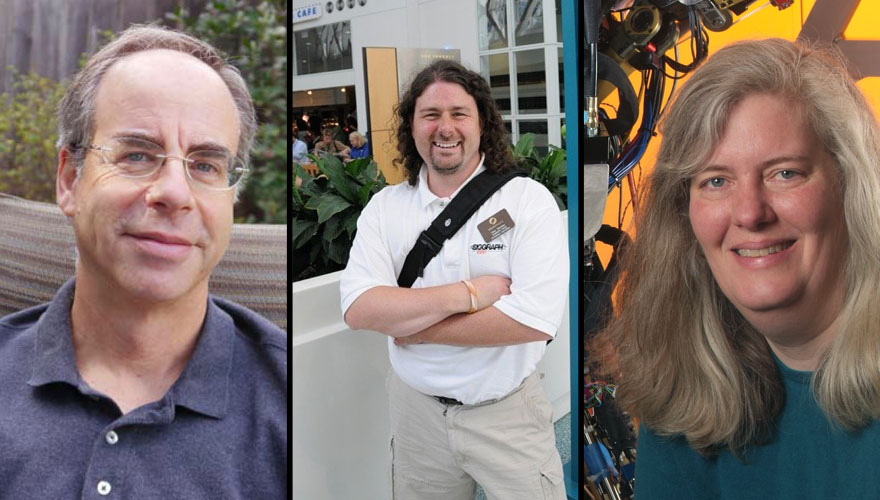
The 2015 ACM SIGGRAPH election results have been announced. Paul Strauss will join the ACM SIGGRAPH Executive Committee as a director-at-large, Dave Shreiner will take over as treasurer and Jessica Hodgins will begin a second term as one of the organization's six directors-at-large. All three will serve three-year terms, beginning on July 1, 2015.
Each of these individuals has been involved with ACM SIGGRAPH and its conferences for a substantial period of time. Paul Strauss, a software engineer who specializes in 3D computer graphics, has attended every SIGGRAPH conference since 1984. In addition to serving as a SIGGRAPH unified juror on multiple occasions, Paul was the courses chair for SIGGRAPH 2013.
Dave Shreiner is an expert in computer graphics and GPU computing, specifically, rendering with OpenGL, and has authored several books and courses on the subject. In 2014, Dave served as the SIGGRAPH conference chair, leading a team of volunteers and staff to orchestrate the 41st occurrence of the world's largest conference on computer graphics, which was an extremely well-received conference.
Jessica Hodgins is a professor in the Robotics Institute and Computer Science Department at Carnegie Mellon University, and VP of Disney Research. Among her many achievements, Jessica has served as editor-in-chief of ACM Transactions on Graphics (2000-2002), was the SIGGRAPH 2003 papers chair, served as the SIGGRAPH 2007 panels chair, and was awarded the ACM SIGGRAPH Computer Graphics Achievement Award in 2010.
ACM SIGGRAPH warmly welcomes Paul, Dave and Jessica to the Executive Committee, where their expertise and passion will help guide the organization on its mission to foster and celebrate innovation in computer graphics and interctive techniques.
Please join us at SIGGRAPH 2015 in Los Angeles, from August 9-13.

 Over the course of his career, Henry Fuchs has made impressive contributions to the fields of augmented reality, virtual reality, telepresence and graphics hardware. In his earliest work, Henry described one of the first 3D digitizing technologies, and went on to contribute much of the foundational work on visibility computation. From there, he developed some of the earliest specialized hardware for computer graphics. Henry has made significant contributions to augmented reality, particularly in the areas of video see-through displays and wide area tracking. Many of these advances have been motivated by applications in medicine; informative visualizations during surgery or exams, and telecollaboration. During a panel at SIGGRAPH 2014, he discussed the historical development of wearable displays, including many pioneering contributions from his laboratory. Henry's contributions to ACM SIGGRAPH extend well beyond his own research. In his 40 years in academia, he has educated and graduated many of the most recognized and accomplished leaders in the field of computer graphics.
  Steve Marschner was selected as the 2015 recipient of the Computer Graphics Achievement Award for his work on modeling the appearance of natural materials. Steve's research has produced the most realistic appearance models to date of many real-world materials. Steve’s research combines three critical ingredients: detailed models of the intricate structure of materials, physically-based simulation of how light interacts with structured materials, and measurement of materials to capture and validate their appearance. Steve Marschner's work has had a deep and profound impact in applications from the entertainment industry to industrial design, and has fundamentally changed how materials like hair, skin, wood, marble and fabric, are modeled, measured and rendered in graphics. In 2004, he shared a Technical Achievement Award from the Academy of Motion Picture Arts and Sciences for significant advances in the realism of computer graphics and animation.
  The 2015 Significant New Researcher Award is presented to Johannes Kopf in recognition of his pioneering contributions to the fields of digital imaging and video, particularly his work on gigapixel panorama viewing, hyperlapse generation, image completion, and image upsampling and downsampling. Johannes’ problem selection is especially creative, and often far afield from other efforts in the area. His 2014 paper, for example, “First-Person Hyperlapse Videos,” brought together technologies from both computer vision and computer graphics. The results were able to successfully convert long-duration sequences from a wearable camera into stable, fast paced and surprisingly watchable video.
  The Outstanding Service Award is presented annually to recognize a career of outstanding service to ACM SIGGRAPH by a volunteer. Mike Bailey's dedication to expanded topics and excellence helped make the SIGGRAPH conference courses program the premier venue for learning the latest techniques. As a result, thousands learned basic and advanced techniques, and contributed to the eventual result that computer graphics became pervasive and economically viable. In addition to his leadership role in education, Mike also served on the ACM SIGGRAPH Executive Committee (1986-1990) and served as the SIGGRAPH conference co-chair in 1991. He helped guide the organization and the conference as a member of its Book Series Editorial Board from 1994 to 1998, and as editor of the SIGGRAPH Technical Slide Set from 1998 to 2000. He is also a longtime member of the ACM SIGGRAPH Education Committee, and a two-time conference education chair.
  Through her groundbreaking work, Schwartz helped to establish computer art as a viable field of endeavor. Her computer art career began as an offshoot of her merger of art and technology. Her kinetic sculpture, Proxima Centauri, exhibited in 1968, was the first in this medium to be acquired by The Museum of Modern Art in New York. Originally a student of Chinese brushwork in the late 1940s in Japan, Schwartz later studied Fine Art in the USA. She always had a keen interest in the combination of art with technology and science. Her very early pioneering work in computer art took place in the 1970s at AT&T Bell Laboratories, IBM’s Thomas J. Watson Research Laboratory and at Lucent Technologies Bell Labs Innovations. Working in a team of creative researchers, she developed effective techniques of motion-graphics-based film and video art that could be viewed in both 2D and 3D.