
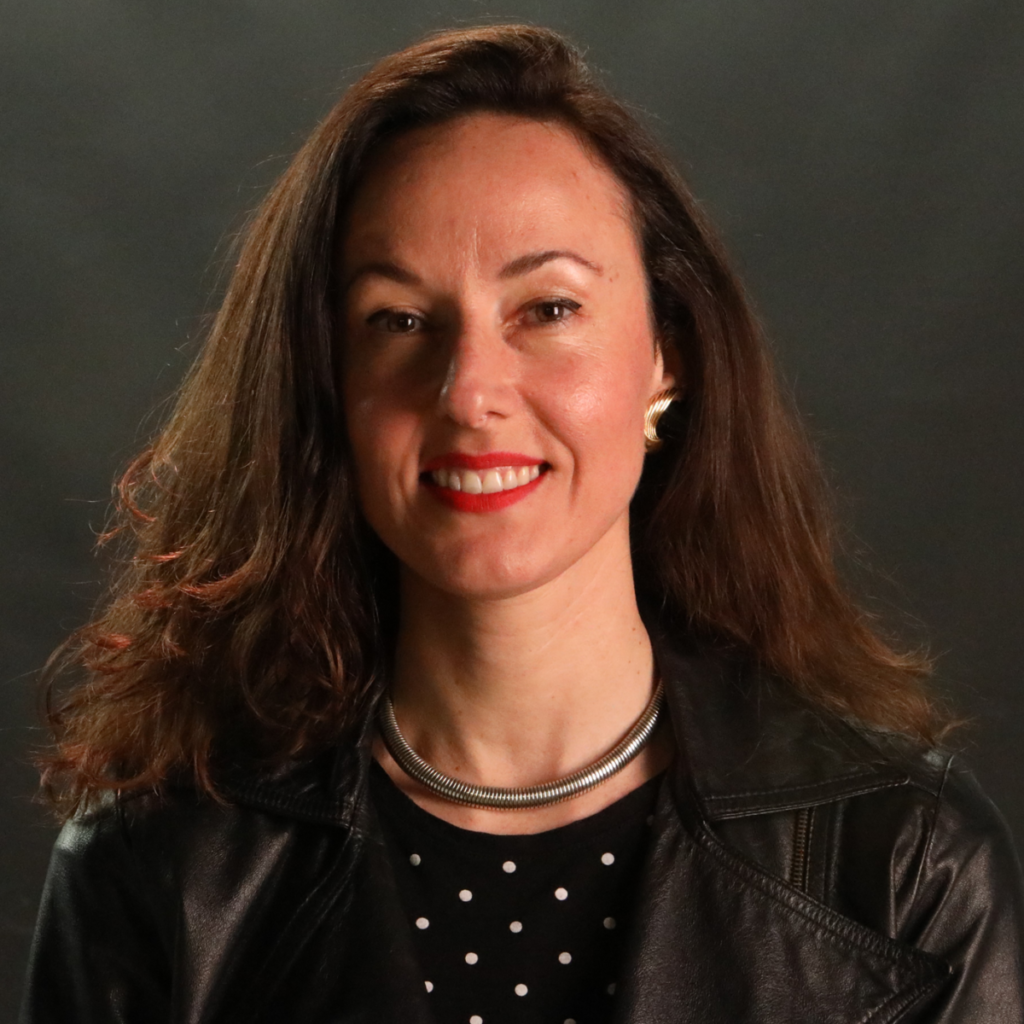
Member Profile: Rochele Gloor
1. What do you do, and how long have you been doing it?
I research, prototype, and implement emerging technologies and generative AI, and develop interdisciplinary and industry partnerships for educational purposes. I also provide mentorship to graduate students and faculty on customized motion capture and animation workflows, as well as different perspectives on experimental arts. I approach this work with 35% experimental and 65% effective and optimized strategies. I have been working on this specific combination of tasks for three years, currently in the MFA Computer Arts program at the School of Visual Arts. However, more than 20 years ago, I was also working on workflow development and research, but in my first career field, medical diagnostics. I have been researching and experimenting since then.
2. What was your first job?
My first job was as an MRI technologist. Besides administering exams, I worked on the reconstruction of volumetric and dynamic image sequences, such as angiographies. It was the beginning of the 2000s in my native town in the south of Brazil, and I assisted physicists with MRI spectroscopy research exams, which I believe were part of the early development of this technology for identifying temporal lobe epilepsy. The results seemed quite theoretical at the time, but the concept was very interesting.
3. Where did you complete your formal education?
I have a Master of Science in Creative Technologies, interdisciplinary track, from the School of Creative Technologies at Illinois State University; a BFA in Fashion Design from the Fashion Institute of Technology (FIT) in New York; and with specialization in computerized knitwear completed at Nottingham Trent University (NTU) in the UK. I also have a Bachelor’s degree in Radiologic Technology from ULBRA in Brazil, which I completed in 2001. I have a distinct career path and understand the implications of those decisions, but I believe there is a relationship between technological and humanistic visual and audio embodiment across all these fields that I am still discovering.
4. How did you first get involved with ACM SIGGRAPH?
My first SIGGRAPH was in 2024, in Denver, which I attended with my colleagues from the MFA Computer Arts program at the School of Visual Arts and several student volunteers. It was, wow, so much information and amazing people. I had a fantastic lunch with Terrence Masson and Andrew Glassner, chatting about quantum computing and his SIGGRAPH talks. After that, during the year, I started attending the Digital Arts Community (DAC) monthly SPARKS talks and participated in the SOIREE organized by the Education Committee. Now I am a collaborator on the Education Committee, a moderator at DAC, and an author and co-author of creative research. Very exciting!
5. What is your favorite memory of a SIGGRAPH conference?
My favorite memory was definitely presenting at SIGGRAPH 2025 in Vancouver. I talked about a case study and a framework in AI & Filmmaking during the Educator’s Forum. I think of myself as an embodied individual, and there are subtleties in the way you give information that can only be translated through bodily reactions in the present moment. There were a lot of people watching the presentation, among them some researchers and scholars whom I admire. Exchanging contacts and thinking about collaborative future developments afterward was a fantastic feeling.
6. Describe a project that you would like to share with the ACM SIGGRAPH community.
I recently published research on a novel method of co-embodiment, One Body, Four Minds: Multi-Person Virtual Co-Embodiment in a Single 3D Body. As the title suggests, it is an experimental method in which four people share control of a single avatar through different parts of sensor-based motion capture equipment and receive real-time visual feedback. It started as a way to scale teaching motion capture, since the concept of artificial embodiment is directly applied by wearing the equipment and embodying oneself in a virtual avatar. I further developed it as research to analyze agency, social interaction, and team dynamics, and I will continue to work on it in 2026 into more artistic performance work involving geometry deformation and interactivity, as well as applications in robotics.
7. If you could have dinner with one living or non-living person, who would it be and why?
I would first say Sigmund Freud, since I am interested in and inspired by all things subjective and pertaining to the mind, but I assume he wouldn’t be as personally open as his literature. Because of that, I would choose to have dinner with Akira Kurosawa. I deeply appreciate his aesthetic decisions and the way he portrays time in such a unique way, as if it were an entity within the film. It would be amazing to talk to him about it.
8. What is something most people don’t know about you?
For many years (starting when I was 19 years old), I was an avid surfer and bodyboarder who lived to catch the best waves possible every single weekend. My friends and I, a large group, would drive up the coast of Santa Catarina, Brazil, on Friday after work, surf for four to six hours a day, and return on Sunday for the working week. It was wild and some of the most beautiful, active times of my life. I have had surf sessions where I watched the sun go down in the sky in different shades, the moon shining, birds flying, dolphins, and a rainbow. Pure magic. It cures every bad workday and problem possible. Currently, I watch Nature. I watch small animals, birds, snails, water, plants, and leaves for several minutes with pure attention. I have learned that the more you watch, the more you see.
9. From which single individual have you learned the most in your life? What did they teach you?
My dad is impossible to overlook. He was a military man. He was strict, brilliant, creative, self-taught, and devoted to innovation and efficiency. The most important thing he taught me, also through his actions, is that I can do and achieve anything I want. He also taught me that perseverance drives success and that authenticity creates character. I learned how to be a strong, independent woman, despite the disputes it may cause, and to be humble, just, and responsible for my actions while playing a positive role in society.
10. Is there someone in particular who has influenced your decision to work with ACM SIGGRAPH?
Nandhini Giri, who is a member of the Education Committee, was very supportive of my first participation as a presenter at SIGGRAPH 2025. I appreciated her point of view on education and computer graphics, as well as the way she communicates them. Glenn Goldman was very important as well. However, the person who influenced me the most was Terrence Masson, a SIGGRAPH pioneer who is the chair of my department and is always encouraging, while also telling great stories about the conference and its people.
11. What can you point to in your career as your proudest moment?
That is a very difficult question, since I have had distinct careers. When I worked with sustainable fashion as a creative director, I founded a social inclusion innovation project in my town to teach women how to upcycle textiles from a designer’s aesthetic perspective. I did this alongside my job for almost four years and learned a lot from them. We built an atelier, collaborated with four universities, and inspired other designers, businesses, and NGOs to invest in people and the circular economy. I unexpectedly received an award for my efforts, which was amazing.
Nowadays, I love watching students succeed, especially those with whom I worked closely, supporting their creative and technological development.