
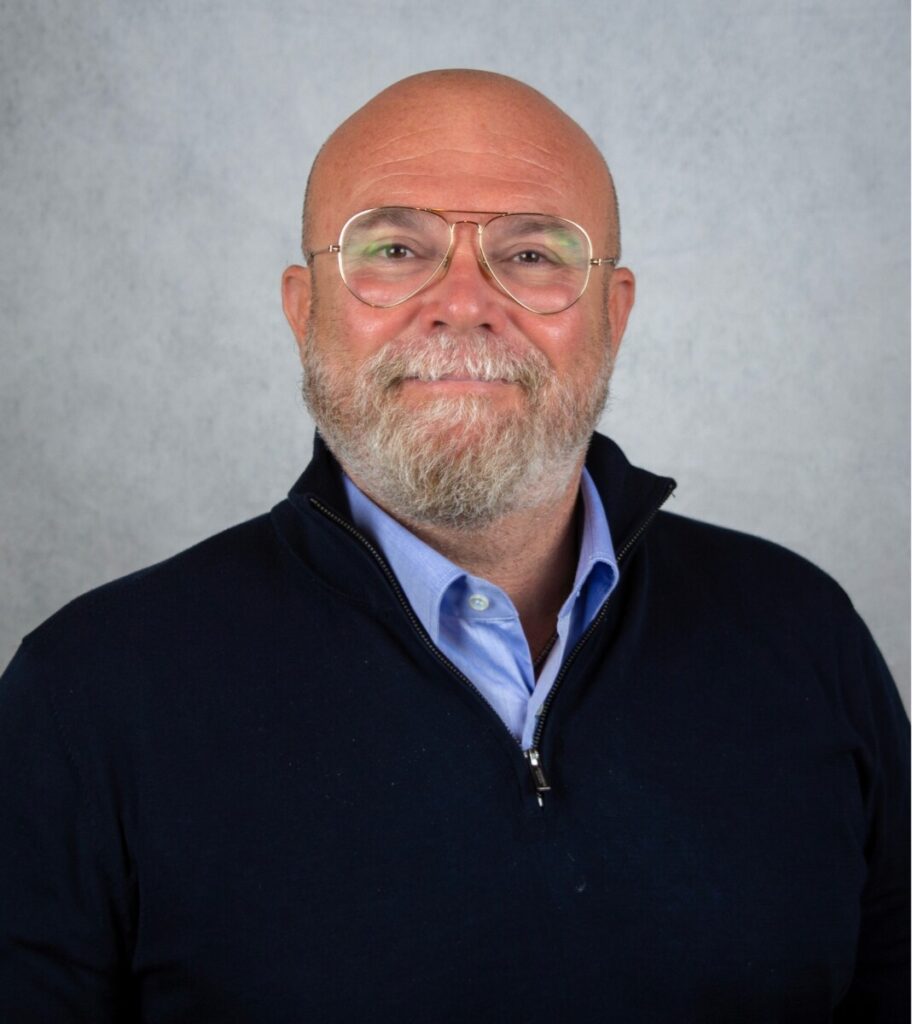
Member Profile: Raffaele DeAmicis
1. What do you do, and how long have you been doing it?
I am an Associate Professor in the School of Electrical Engineering & Computer Science at Oregon State University. My work focuses on interactive computer graphics, extended reality systems, HCI, and software engineering for immersive environments. Over the past two decades, I have worked at the intersection of research, innovation, and education, advancing XR technologies from foundational research to real-world deployment.
My early career included research positions at the Fraunhofer Institute for Computer Graphics and the Technical University of Darmstadt. In 2003, I was appointed Managing Director of Fondation GraphiTech, a center for advanced computer graphics technologies in Italy, where I had the opportunity to lead multidisciplinary research initiatives and build international collaborations across academia, government, and industry.
I have been active in computer graphics and immersive systems for more than twenty-five years, and what continues to motivate me most is mentoring students and building international research cooperation that connect technology with societal impact.
2. What was your first job?
My first job (1994) was as an undergrad research assistant in the Department of Mathematics at the University of Calabria. My specific assignment was supporting the design of synthetic images, and, in a way, it felt almost “esoteric” at the time: learning how to generate computer-created imagery from a text-based scene description, translating words and parameters into geometry, light, materials, and ultimately a rendered image. That early experience made a lasting impression on me and strongly influenced my long-term interest in visual computing.
3. Where did you complete your formal education?
I studied at the University of Calabria, where I enrolled in Mechanical Engineering in 1989 and graduated in 1995 with a MS thesis titled “Quantitative analysis of interferometric fringe systems: phase reconstruction and unwrapping.”.
After qualifying as a professional engineer in 1997, in 1988, I was awarded with a fellowship to join the Ph.D. program in Design and Methods of Industrial Engineering at the University of Bologna. I completed my Ph.D. in 2001 with a dissertation titled “Free-Form Surface Modeling in Virtual Reality”, which marked a pivotal shift toward the immersive and interactive environments that continue to shape my work today.
4. How did you first get involved with ACM SIGGRAPH?
I became involved with ACM SIGGRAPH through my early research in interactive visualization and immersive systems. SIGGRAPH represented the intellectual home of computer graphics excellence, where art, science, and technology converge.
5. What is your favorite memory of a SIGGRAPH conference?
My favorite SIGGRAPH memory is actually one I’m still looking forward to making: the next SIGGRAPH I attend. Because of a health situation, I haven’t been able to participate in conferences for the past nine years, so returning to SIGGRAPH would mean more than simply catching up on the latest work. It would be an opportunity to reconnect with the community, experience that creative energy in person again, and celebrate being back. Who knows, maybe SIGGRAPH 2026 (or 2027 ..) will be the most meaningful one yet.
6. Describe a project that you would like to share with the ACM SIGGRAPH community.
I would like to share my work on XR-driven digital twins for Smart Forestry. This project integrates immersive visualization, AI-based scene understanding, and interactive simulation to model forest ecosystems and mass-timber supply chains. By combining high-resolution spatial data with real-time rendering and immersive analytics, we are building tools that support sustainable forestry practices and rural workforce development. The project exemplifies how computer graphics and XR can extend beyond entertainment into environmental stewardship and industrial transformation.
7. If you could have dinner with one living or non-living person, who would it be and why?
I’d choose Plato, and not only because the “Allegory of the Cave” connects so directly to my work in immersive and interactive environments, but because I’d be genuinely curious to hear his take on today’s society, where digital “shadows” are everywhere.
Over dinner, I’d ask what he thinks about the proliferation of digital illusion, feeds engineered for attention, hyper-real media, and experiences designed to feel more compelling than everyday life. The Cave feels uncannily modern: many of us spend hours each day watching carefully curated projections of reality, and those projections can shape what we believe, value, and even who we think we are.
I’d also want his perspective on addiction and habituation: what happens when people become attached to the comfort, stimulation, or certainty of the shadows, and resist turning toward more complex truths? And if he still believes education is a kind of “turning,” I’d ask what good digital experiences should do, how interactive and immersive systems might be designed to cultivate reflection, agency, and wisdom rather than dependency.
That conversation would matter to me personally, because the same tools that can enable creativity, learning, and empathy can also intensify distraction and manipulation. Plato would be the perfect dinner guest to help interrogate that tension, what we build, why we build it, and what it does to us.
8. What is something most people don’t know about you?
Most people don’t know that one of my favorite ways to unplug is spending time by the sea with a fishing rod, though these days I do it very very rarely. In my mind, it feels like a little Taipei-cartoon moment: a quiet figure on the seawall, rod in hand, waves rolling in, everything slowing down.
The funny twist, unlike the cartoon version, is that I’m not really fishing. I’m mostly just feeding the fish and enjoying the calm. It’s less about catching anything and more about being present, watching the water, and letting my mind reset.
9. From which single individual have you learned the most in your life? What did they teach you?
The single greatest influence in my life has been my parents, my father and my mother. If I have to name one “individual,” I can’t honestly separate their impact; they shaped the same foundation of values that I still rely on every day.
As the PI on a number of mid- to large-scale projects, often bringing together multiple organizations across research, academia, and industry, I’ve learned that technical excellence is only part of what makes collaborations succeed. The principles my parents instilled in me are what consistently make the difference: integrity, humility, respect for others, and keeping your word. They taught me to listen carefully before acting, to treat people fairly (especially when there’s pressure or disagreement), and to do the work in a way that earns trust over time.
Most importantly, they taught me that leadership isn’t about being the loudest voice, it’s about responsibility, consistency, and helping others succeed together. Those values have become fundamental to how I build teams and collaborations.
10. Is there someone in particular who has influenced your decision to work with ACM SIGGRAPH?
Senior colleagues in the computer graphics community played a major role. Their commitment to open exchange, constructive reviewing, and interdisciplinary dialogue reinforced my belief that SIGGRAPH is more than a conference; it is a global network of innovators shaping visual computing.
11. What can you point to in your career as your proudest moment?
What I can point to as my proudest moment isn’t a single paper or award, it’s each time I’ve built an XR lab. And I did it a few times, literally from the ground up. I’ve worked in several different places, and in every location, I’ve found myself doing the same thing: creating a space where immersive and interactive ideas can become real, testable, and shareable.
To me, an XR lab is not just a room with computers and keyboards. It’s a living system: a carefully assembled set of devices, headsets, sensors, tracking, input devices, display and visualization systems, capture tools, and software infrastructure that can be reconfigured and recombined to prototype entirely new interaction paradigms. The best XR work often happens in the “in-between” spaces, where you connect tools in unexpected ways, iterate quickly, and discover what a new form of interaction could feel like before it even has a name.
But the part I’m proudest of isn’t only the technology, it’s the users of the lab: the students, scientists, collaborators, and colleagues who brought it to life. These labs became places where friendships were forged, mentorship happened naturally, and teams formed across disciplines. They are where projects moved from sketches to prototypes to deployments, and where people grew into confident researchers and builders.
In that sense, every XR lab I’ve built is both an infrastructure for innovation and a community, and that combination is what I’m most proud of.