
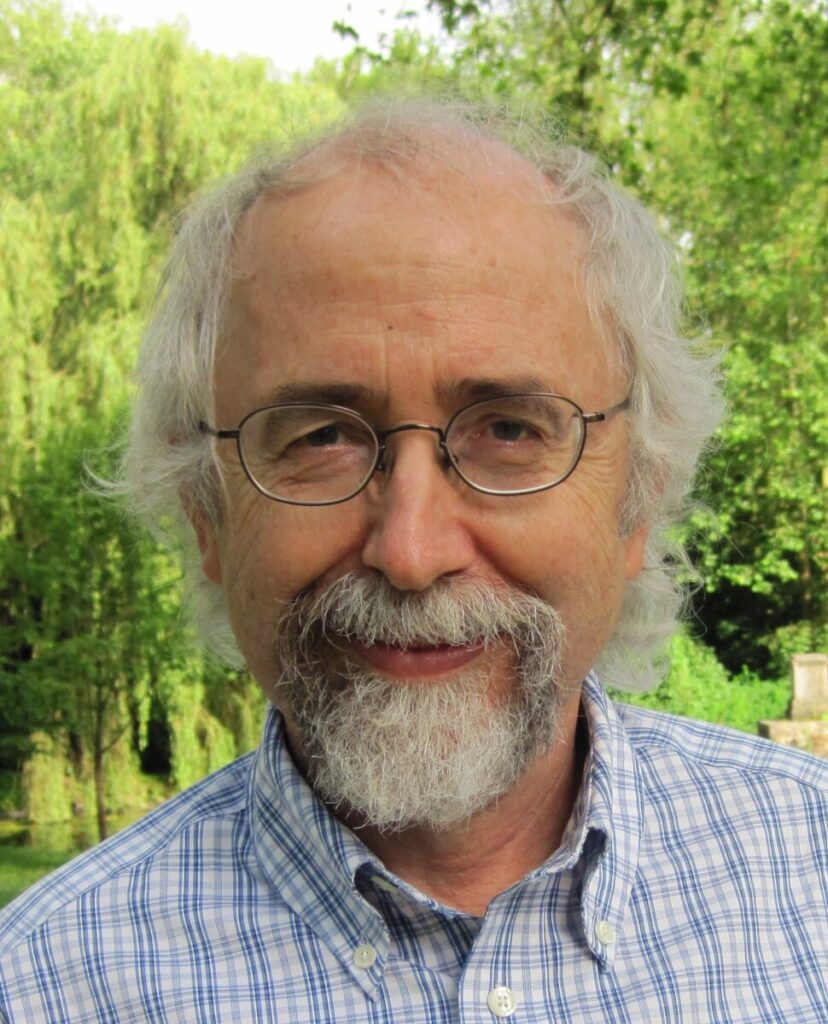
Member Profile: Przemyslaw Prusinkiewicz
1. What do you do, and how long have you been doing it?
The main direction of my research is procedural modeling of plants. I was inspired by Alvy Ray Smith’s opening talk at the first SIGGRAPH conference I ever attended (Minneapolis, 1984), and the infinite zoom into a geometric pattern of vines shown in Omnimax at that conference. Initially I was fascinated by the possibility of synthesizing complex, realistic-looking plant images using very compact procedural models. The connections between formal languages (in particular, L-systems), fractals, and plants were also very attractive to me. Eventually my interests extended to the use of models and simulations as a tool for investigating biological mechanisms of plant development. This combination of computer science, biology, and art continues to motivate my work to this day.
2. What was your first job?
As a teenager, during summer vacations I was a helper in a greenhouse, doing odd jobs that did not require any qualifications.
3. Where did you complete your formal education?
I got my degrees, M.Sc. (1974) and Ph.D. (1978), both in computer science, from the Technical University of Warsaw, Poland.
4. How did you first get involved with ACM SIGGRAPH?
In late 1970, while still working on my Ph.D. (on the theory of error-detecting and error-correcting codes), I became interested in computer graphics as an area integrating computer science with geometry, my favorite topic since high school. I then found out about SIGGRAPH, joined it to receive conference proceedings and slide sets, and things progressed from there.
5. What is your favorite memory of a SIGGRAPH conference?
Throughout 1989 I was working with my collaborator, Prof. Aristid Lindenmayer (the inventor of L-systems), and my students on a book, “The Algorithmic Beauty of Plants”. The publisher (Springer) launched it at SIGGRAPH 1990 and threw a reception, at which my students and I had the opportunity to meet and talk to many computer graphics luminaries. It was a special, very rewarding day.
6. Describe a project that you would like to share with the ACM SIGGRAPH community.
So many projects, so little time… For example, one problem that has continued to puzzle me for over 20 years is the patterning of leaf veins. Open patterns (without loops) are more or less understood, but closed patterns are not. How do plants make them? There have been many attempts to address this problem, but fundamental, comprehensive insights remain elusive.
7. If you could have dinner with one living or non-living person, who would it be and why?
This is a difficult question. For example, I would like to meet Cleopatra and find out what made her persona so attractive, but I cannot imagine how to bridge the time gap – would the conversation take place in antiquity? Now? Sometime in-between? So, among living persons, I would choose Demis Hassabis. I am fascinated by his pursuit of AI as a tool for advancing science and by his very original scientific trajectory: outside the typical context of academia, by setting up the DeepMind company.
8. What is something most people don’t know about you?
I got a banjo for my 50th birthday. Still learning to play…
9. From which single individual have you learned the most in your life? What did they teach you?
I learned a lot from many people: my parents, teachers, collaborators, and colleagues. But my most influential mentor was the late Professor Aristid Lindenmayer. In the short period of our collaboration (we first met in 1986; he passed away in 1989) he introduced me to the world of mathematical problems in plant science, in which I have been immersed ever since. He also became my role model as a scientist: driven by genuine curiosity and always willing to share his knowledge.
10. Is there someone in particular who has influenced your decision to work with ACM SIGGRAPH?
It would probably be Heinz-Otto Peitgen, who invited me to lecture at the SIGGRAPH Course on Fractals in 1988. I continued lecturing at SIGGRAPH courses every year until 2003.
11. What can you point to in your career as your proudest moment?
Receiving the SIGGRAPH Achievement Award in 1997.