
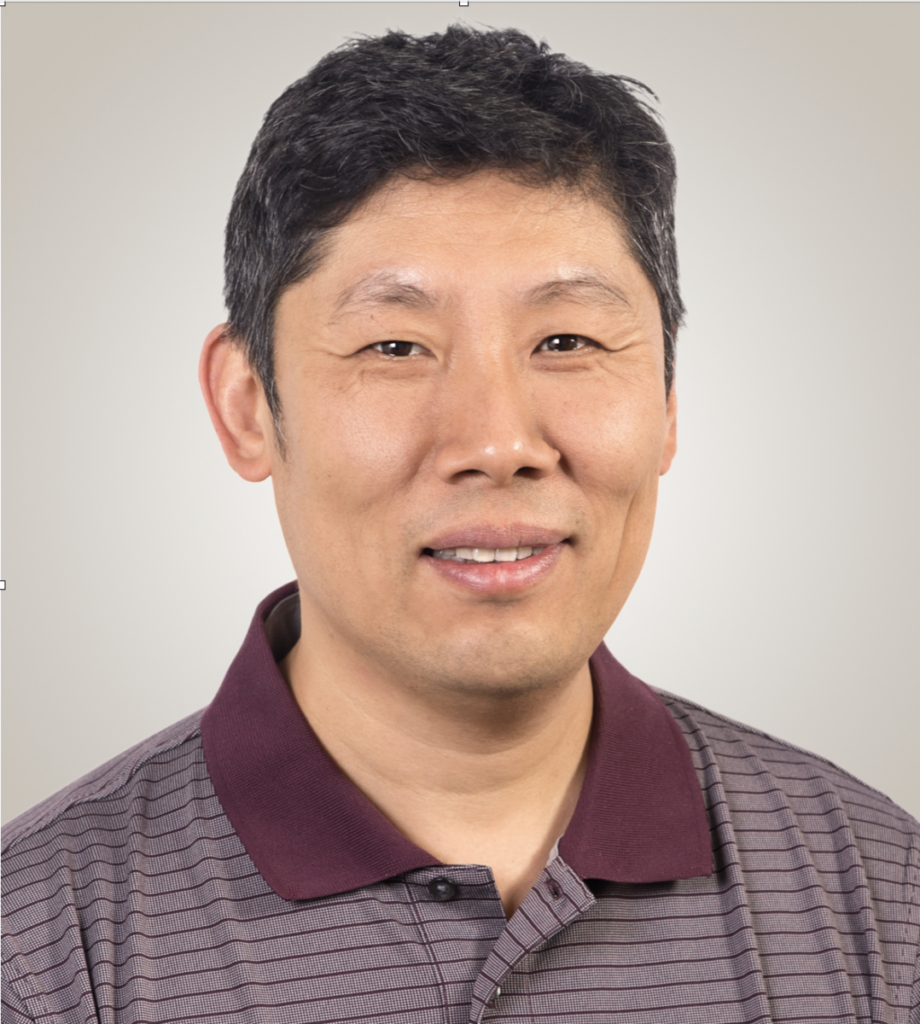
Member Profile: Eugene Zhang
1. What do you do, and how long have you been doing it?
I am a researcher in Computer Graphics and Visualization, and a Professor at Oregon State University. My research in Graphics is part of Digital Geometry Processing, with a focus on the theories and applications of various types of fields: scalar fields, vector fields, tensor fields, and rotational symmetry fields. In Visualization, I have been working on Scientific Visualization problems that arise from engineering and medicine and Information Visualization problems that address large hierarchical data and network data. I have been teaching Graphics, Geometric Modeling, and Visualization classes at my school. This is the twenty-second year for me at my position.
2. What was your first job?
My first job was to serve as a graduate teaching assistant in the Math department at Ohio State University, where I taught recitations and then lectures for evening classes. My first (real) job outside a university was to work as a database software developer and then the manager of the Customization Group in a software company headquartered in South Carolina with over three thousand of employees globally. I worked with many clients all over the US to provide technical consulting and in the meantime provided internal support to our sales team. To ensure timely delivery of high-quality software products, I also worked closely with developers in my group and visited clients on-site to ensure smooth deployment and gather feedback.
3. Where did you complete your formal education?
I received my M.S. degrees at Ohio State University and my Ph.D. at Georgia Tech’s College of Computing.
4. How did you first get involved with ACM SIGGRAPH?
It was easy. Every year, everyone at the GVU Center at Georgia Tech was working on some SIGGRAPH submission, and I wanted to be part of that. I attended my first SIGGRAPH in 2000 in New Orleans as a Ph.D. student. I have been attending the conferences regularly since then. The size of the audience, the quality of the papers, the innovation from emerging technology and animation theater, and the mixers with industry collaborators continue to amaze me.
5. What is your favorite memory of a SIGGRAPH conference?
There are many fond memories. My favorite is when my whole family was there with me in 2007 in San Diego. My older one was just two-year old and was awed by the people and the food at the reception. That year, my students and I had one SIGGRAPH paper, one SIGGRAPH technical sketch, and one SIGGRAPH poster. My three students and I all attended the banquet. Their excitement was another highlight for me.
6. Describe a project that you would like to share with the ACM SIGGRAPH community.
It is really hard to pick a favorite project as I enjoy all my projects. I recently worked on a math visualization project in which we used mirror mazes as the visual metaphor to help math and non-math audience to understand the mathematical notion of Orbifolds. The concept was developed in the second half of last century, and it played an important role in low-dimensional topology and hyperbolic geometry. I first came into contact with the concept as a Math graduate student but did not really understand what it was, nor its significance. However, at a talk in 2012 where someone talked about kaleidoscopes, the memory of Orbifolds came up. Empowered with the ability to program and to render, I started a project of designing mirror mazes and using them to help people understand Orbifolds. Along the way, we used Group Theory to characterize the symmetry in mirror reflections, Möbius transformations to realize non-Euclidean spaces, and Topology to enumerate all possible two-dimensional kaleidoscopic Orbifolds. Moreover, the project opened up many new questions such as how to represent shapes in non-Euclidean spaces and how to correctly and efficiently render mirror scenes.
7. If you could have dinner with one living or non-living person, who would it be and why?
There are so many people (living, historical, fictional) that I would like to meet and have dinner with. Probably Riemann, as in Riemann Sums from Integral Calculus, Cauchy-Riemann Equations from Complex Analysis, Riemann Surfaces from Differential Geometry, and Riemann-Hurwitz Formula from Topology. For a person who died before reaching the age of 40, Bernhard Riemann showed both genius and passion for Math. I would certainly want to get his view on AI, quantum computing, and the future of humanity over dinner.
8. What is something most people don’t know about you?
I am an avid player of Go, the ancient board game that inspired AlphaGo. In 2016, I watched all five games between AlphaGo and Lee Sedol, live, despite the time difference. I am working on combining Go with my Graphics and Visualization research and have a joint publication on the use of Eye-tracking techniques to analyze the gazes of Go players during online play.
9. From which single individual have you learned the most in your life? What did they teach you?
I have learned from so many people. However, I would go with Greg Turk, my Ph.D. advisor. Before becoming his student, I was at a stage where I was about to quit graduate school and join a game company. It was Greg as a kind person and a seasoned researcher that convinced me to stay and finish my degree. He showed me how to do research by focusing on one problem at a time and go in-depth. His advice and demonstration of a balance between work and family life have benefited me long after I left Georgia Tech. I still apply what I learned from him each day in my research, advising, and grant writing. Over the years, I still read papers by Greg and show them to my own children and my students.
10. Is there someone in particular who has influenced your decision to work with ACM SIGGRAPH?
Gabriel (Gabe) Brostow. He was a friend and a mentor of mine at the GVU center. Gabe was always enthusiastic, friendly, and ready to help. Gabe’s encouragement led me to try to send a paper on computer-generated paintings to SIGGRAPH in my second year at Georgia Tech. Unfortunately, I was not quite ready at the time, and the project was put on hold. However, the idea and techniques that I learned in that self-identified project eventually became an essential component in my Ph.D. thesis.
11. What can you point to in your career as your proudest moment?
In 2016, I gave a tutorial at SIGGRAPH ASIA on the rotational symmetry fields that I have been working on since 2005. As I prepared the slides, I thought of all the people whom I have worked with for this endeavor: my students and my collaborators from around the world. I was very proud of my students. I was also very thankful of the opportunities to have met and collaborated with many bright minds that inspired me and helped me grow as a researcher and a person. I was proud that I made some solid contributions to the field, including, perhaps, coining the term “N-RoSy” for N-way Rotational Symmetries, and extending and adapting my own dissertation research from vector field design to the design and processing of N-RoSy fields.