
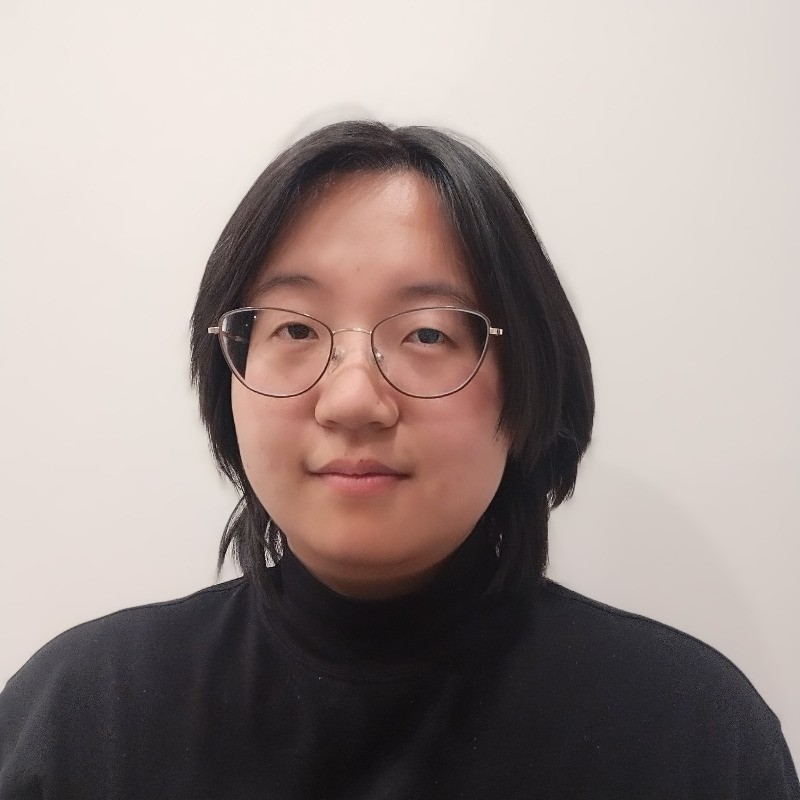
Member Profile: Xuan Huang
1. What do you do, and how long have you been doing it?
I work on visualizing large spatial datasets. My first exposure to 3D graphics was during my junior year as an undergraduate, when we built a retro Space Invaders game in OpenGL. I stayed in the field through graduate school, which lasted 6.5 years for me, and I have now been working in the geospatial industry, focusing on data visualization, for about 1.5 years.
2. What was your first job?
My first job is my current role at Cesium/Bentley as a Graphics Software Engineer on the tilers team. We turn heterogeneous data into scalable data structures for real-time streaming and visualization.
3. Where did you complete your formal education?
I completed my Bachelor of Arts degree in Computer Science at Bryn Mawr College under the supervision of Dianna Xu, and my PhD in Computer Graphics and Data Visualization at the University of Utah’s Scientific Computing and Imaging Institute (SCI) under the supervision of Valerio Pascucci.
4. How did you first get involved with ACM SIGGRAPH?
As a continuation of my undergraduate thesis, I submitted a poster on 2D mesh simplification to SIGGRAPH’s 2017 student program and won third place that year. It was at the Los Angeles Convention Center, and I still remember the giraffe on the second floor.
5. What is your favorite memory of a SIGGRAPH conference?
The VR experience was really impressive when I attended in 2017. It was great to see the most cutting-edge devices and what they could achieve with immersive storytelling crafted by filmmakers and game makers. I usually get motion sickness almost immediately in any VR headset, but I stayed in the booth for more than half an hour and didn’t feel any that day. The freedom to look and walk around in a smooth, meaningful virtual scene really struck me and showed me that it is possible to solve a problem this complicated.
6. Describe a project that you would like to share with the ACM SIGGRAPH community.
Check out the distributed rendering work we did for large AMR meshes with irregular volume distributions! It’s called Approximate Puzzlepiece Compositing, named for its scalability regardless of boundary shape. The technique builds on Moment-Based Order-Independent Transparency, which removes the need for sorting as a whole while maintaining the high accuracy necessary for scientific analysis.
7. If you could have dinner with one living or non-living person, who would it be and why?
I would have dinner with Dr. Norm Badler. I did an internship with him during the last summer of my undergraduate years and happened to meet him again that year at SIGGRAPH, where he brought me around, introduced me to different researchers, and encouraged me to have conversations with them. That was the pivotal point when I decided to pursue a PhD after college, as the world of graphics unfolded in front of me in a challenging but still realistic way. He was extremely generous with his knowledge, both academically and in terms of career growth.
When I graduated from Utah and joined Cesium, I saw him at a gathering once and said thank you, but he had to leave quickly. He passed away a couple of weeks later. I always wonder what he would say about the academic work he inspired me to do, and what wise words he would offer again to a young professional in the industry.
8. What is something most people don’t know about you?
I have had quite a bit of gray hair since I was around 10 years old.
9. From which single individual have you learned the most in your life? What did they teach you?
My mom. She’s the engineer in the house and taught me about typing, computers, and basic household electricity. She and my dad still want to hear about what I do and try to understand it, even when the subject is completely different from her domain.
10. Is there someone in particular who has influenced your decision to work with ACM SIGGRAPH?
It’s hard to find someone working in graphics who is not connected to ACM SIGGRAPH in some way. I’d say there have been many people cheering me on to work with this community, and it’s an honor to be able to contribute to it as well.
11. What can you point to in your career as your proudest moment?
Probably when my first paper came out after three years of various challenges and rejections. That was the moment I learned the right way to deal with difficult things: do things right and continue doing so; the result will come when it comes.