
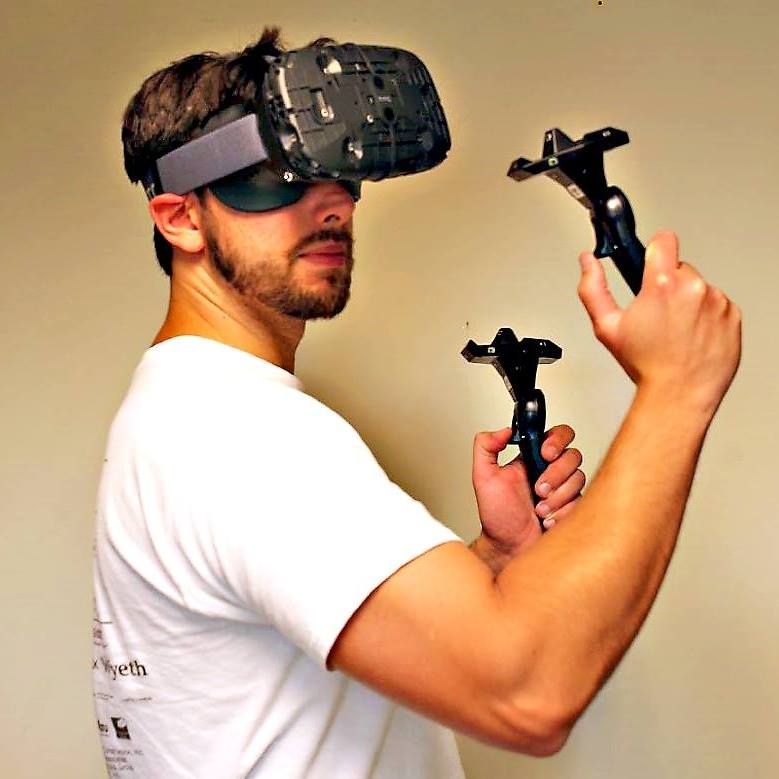
Member Profile: Joseph Theodore Kider Jr.
1. What do you do, and how long have you been doing it?
I’m a university professor specializing in computer graphics, data visualization, and extended reality. I’ve been teaching and conducting research in these areas for several years, helping students develop both the technical and creative skills needed to design interactive visual experiences and emerging technologies.
2. What was your first job?
I worked as a web developer for my undergraduate university, building both front-end and back-end applications in ColdFusion. One of the highlights was helping develop the university’s virtual tour website, which was a relatively novel offering for universities at the time.
3. Where did you complete your formal education?
I earned my undergraduate degree from the Catholic University of America, where I also interned at the Naval Research Laboratory under Larry Schuette, working on some pretty cool projects for the Navy and Marines. I earned my PhD from the University of Pennsylvania, where I worked under Norm Badler. My research focused on simulating time-varying rough surfaces to create more realistic digital environments. Afterward, I completed a postdoctoral fellowship with Don Greenberg at Cornell University’s Program of Computer Graphics.
I’ve been fortunate to work with several influential figures in computer graphics throughout my career and to gain firsthand insight into different approaches to research, innovation, and the advancement of the field. Working with Don Greenberg reinforced the importance of pursuing research that is not only technically novel but also meaningful and impactful, a perspective that has shaped my own approach to both scholarship and teaching.
4. How did you first get involved with ACM SIGGRAPH?
I first became involved with ACM SIGGRAPH while I was a graduate student at the University of Pennsylvania, which had a very active ACM SIGGRAPH student chapter. I attended my first ACM SIGGRAPH conference in 2005 and quickly learned that “SIGGRAPH is a marathon, not a sprint”. The conference was an incredible immersion into the computer graphics community, with far more talks, courses, papers, exhibits, and networking opportunities than anyone could experience in a single week. That first experience taught me the value of how important a community SIGGRAPH is.
5. What is your favorite memory of a SIGGRAPH conference?
My favorite SIGGRAPH memories aren’t tied to a particular paper, presentation, or event, they come from the people I’ve met along the way. Some of the best connections happen in the most unexpected places: chatting with someone while waiting in line for a Pixar teapot, striking up a conversation between sessions, or meeting someone new at an evening reception or after-party. Over the years, I’ve found that SIGGRAPH is full of spontaneous encounters, many of which have led to lasting friendships and professional relationships. Those random moments of connection are what I remember most fondly and what keep me coming back year after year.
6. Describe a project that you would like to share with the ACM SIGGRAPH community.
I don’t just like writing code, I also enjoy building things that connect computation to the real world. That mindset was strongly shaped during my time at Cornell, where Don Greenberg’s work on the famous Cornell Box demonstrated the importance of physical validation in rendering research. One of my favorite projects was capturing spectral measurements of the sky. We hauled a spectroradiometer, along with computers and cameras, up to the often icy roof in Ithaca to collect real-world data and validate our algorithms against physical measurements of light in the atmosphere. It was a deeply interdisciplinary effort, bringing together a team with different areas of expertise to tackle a truly transdisciplinary problem. The experience reinforced for me the value of grounding graphics research in real measurements and real-world phenomena, rather than treating it purely as a computational exercise.
7. If you could have dinner with one living or non-living person, who would it be and why?
I would choose Bernhard Riemann. I believe he was one of the most influential mathematicians in history, and the impact of his ideas continues to shape modern science and technology. I would love the opportunity to hear how he approached problems, developed such revolutionary ideas, and viewed the relationship between mathematics and the physical world. His ability to see deep connections between seemingly unrelated concepts is something I find both inspiring and fascinating.
8. What is something most people don’t know about you?
I have deep love and passion for cats. My current feline companions are named Pixel, Voxel, and James Clerk Maxwell.
9. From which single individual have you learned the most in your life? What did they teach you?
I would have to say, Don Greenberg. Anyone who knows Don knows he is a force of nature, but always has a smile on his face. As one of the original pioneers of computer graphics and a foundational figure in the field, he helped shape what modern graphics research and education look like today. I spent 4 years in Ithaca working with Don, and it was a blast. What influenced me most, though, was the way Don approached problems. He combined a deep technical rigor with an extraordinary sense of vision, always pushing you to think not just about whether something could be done, but why it mattered and how it fit into the broader evolution of the field. That mindset of balancing detail with long-term impact has stayed with me throughout my career. Just as important, if not more so, was his passion for his students. He invested deeply in their growth, both as researchers and as people, and that sense of mentorship and care has had a lasting impact on how I approach teaching and advising.
10. Is there someone in particular who has influenced your decision to work with ACM SIGGRAPH?
When I was a graduate student at Penn, there was a strong sense of excitement and energy around SIGGRAPH. I’ll credit Norman Badler and Steven Lane for getting me excited about attending and participating in the SIGGRAPH community.
11. What can you point to in your career as your proudest moment?
My proudest accomplishment is the students I’ve had the opportunity to supervise and work with over the years. From the DMD/CGGT students at Penn who have gone on to become leaders at Pixar, Disney, DreamWorks, and EA, to my students at Cornell and my PhD advisees, I’ve been fortunate to work with incredibly talented people at every stage of their development. What means the most to me is seeing those students succeed, grow into their own careers, and go on to do remarkable things in the field. Their achievements are the most meaningful reflection of my work, and that impact is what I’m most proud of.