
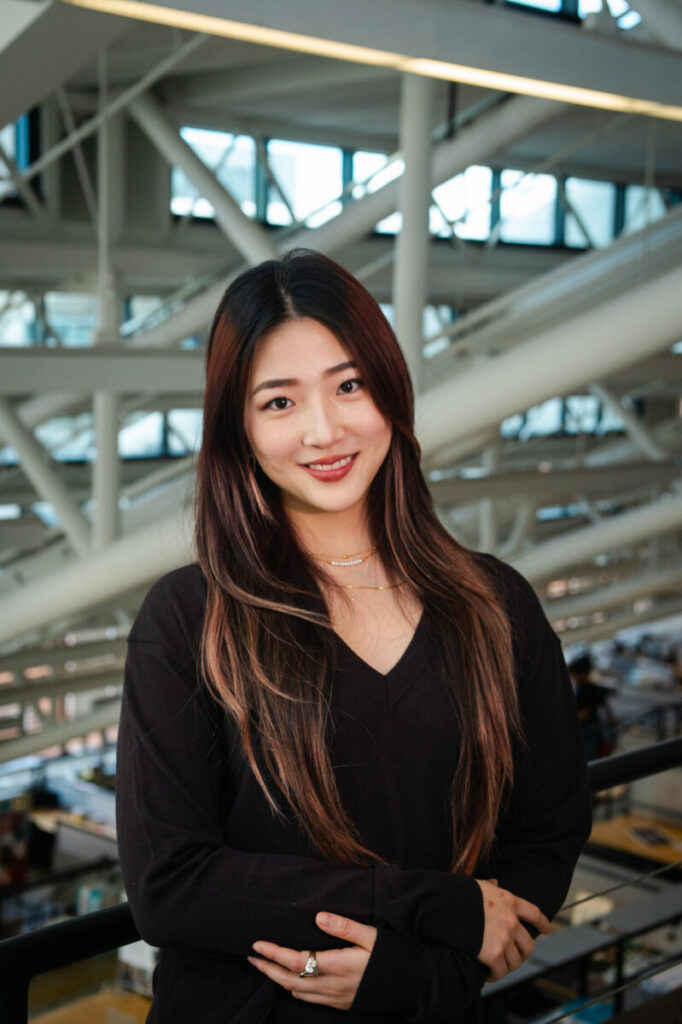
Member Profile: Annie Xing
1. What do you do, and how long have you been doing it?
I work at the intersection of computational fabrication, interactive systems, and material research, making invisible phenomena like material behavior and bodily signals tangible. I originally trained in fashion design, and my work now bridges that creative foundation with technical experimentation spanning computational fabrication, simulation, and human-computer interaction. Over the past few years, my goal has been to merge the expressive materiality of fashion with computational methods, finding ways to imbue technology with new aesthetics and changing how we visually and physically interact with technological development.
2. What was your first job?
My first design job was at The Fabric Union in Shenzhen, where I worked as an assistant fashion designer on ready-to-wear collections, from initial design and pattern making through final production. That hands-on experience with garment construction still grounds how I think about materials and physical fabrication today.
3. Where did you complete your formal education?
I earned a dual degree from The New School, a BFA in Fashion Design from Parsons School of Design and a BA in Economics from Eugene Lang College. I am currently completing my Master in Design Studies (Mediums) at the Harvard Graduate School of Design, alongside my research at the Critical Matter Group in MIT Media Lab.
4. How did you first get involved with ACM SIGGRAPH?
I first got involved with ACM SIGGRAPH through my research at the Critical Matter Group, where my amazing teams and I developed two Art Papers for SIGGRAPH 2026: Resonance, a brain-computer interface installation, and Electrospun Fields, a nanofiber material computation study. Presenting both works at the conference became my entry point into this incredible community.
5. What is your favorite memory of a SIGGRAPH conference?
My favorite memory is presenting Resonance and receiving the Best Art Paper award. But what made it truly unforgettable was what happened after the session ended. People from so many different disciplines approached us with thoughtful questions, unexpected ideas, and their own interpretations. Discovering how deeply the audience resonated with something we cared so much about, and meeting so many fascinating minds through those conversations, was the most rewarding part of the entire conference.
6. Describe a project that you would like to share with the ACM SIGGRAPH community.
I would love to share Superposition, an interactive garment that translates the quantum observer effect into responsive fashion. Inspired by Schrödinger’s cat and the double-slit experiment, the garment remains in perpetual motion, its 3D-printed parametric textiles expanding and contracting like breathing, until AI facial recognition detects an observer in front of it. At that moment, the movement collapses into a single, still form. Just as quantum particles exist in potential until observed, and just as our identities shift across social encounters, the garment materializes Marcel Duchamp’s idea that a work of art is completed by its spectator. The project asks: if observation shapes both quantum states and social identities, can a garment exist in superposition, and can we?
7. If you could have dinner with one living or non-living person, who would it be and why?
Hussein Chalayan. Long before fashion technology existed as a field, his runway shows in the late 1990s and early 2000s already featured motorized dresses that transformed on the body, furniture that became garments, and silhouettes that mechanically reshaped themselves. Like Galliano and McQueen, he understood the runway as theater, but where they reached for drama through fantasy and spectacle, Chalayan built his poetry from mechanisms, engineering, and ideas. He was the first to show me that fashion and technology are not opposing languages but can speak as one, that a garment can be both engineered and emotional. That realization set the entire direction of my practice. I would love to ask what he believed technology could express about the body that fabric alone could not.
8. What is something most people don’t know about you?
Most people don’t know that I hold a degree in Economics alongside my design training. In undergrad, I spent my mornings in draping studios and my afternoons debating political economy and competing theories of capitalism. Had I not pursued design, I would likely have gone into mathematics or the sciences. That analytical foundation remains central to my practice today, from writing generative algorithms to calibrating robotic fabrication systems.
9. From which single individual have you learned the most in your life? What did they teach you?
My mother. Growing up, she made sure I experienced many sides of the world, volunteering at children’s welfare institutes, taking art classes together from calligraphy to oil painting to pottery, and sharing in her Buddhist practice and meditation. She is the kind of person who is endlessly curious and wants to learn everything, at one point even considering learning to pilot a plane. I have come to see her breadth as her greatest gift to me. Watching her approach the world with such openness taught me that curiosity over certainty across many subjects is not a distraction from depth, but the foundation for it.
10. Is there someone in particular who has influenced your decision to work with ACM SIGGRAPH?
Dr. Behnaz Farahi, director of the Critical Matter Group at the MIT Media Lab. Long before I met her, her work was one of my major influences in bridging design and technology, showing me that rigorous computational research and poetic artistic expression can coexist. Her work reshaped what I believed my direction could become. Getting to work under her guidance has been a true privilege. She saw potential in me before I fully saw it myself, inviting me into the lab and trusting me with research that stretched my abilities. As a mentor, she pushes me to grow while giving me room to explore, and she gave me the opportunity to be part of the projects that became our SIGGRAPH Art Papers. She is the reason I found my place in this community.
11. What can you point to in your career as your proudest moment?
Showcasing Superposition at London Fashion Week in September 2024 and later seeing it featured in ELLE UK. My proudest part was more about the path that led there. Coming from a traditional fashion and tailoring education, I stepped outside the curriculum and had to piece the knowledge together myself, reaching out across disciplines to find resources and mentors. When the work received recognition, it marked the milestone where my self-driven detour into technology became a real direction. It remains the moment I point to when I doubt whether an unfamiliar path is worth taking.